


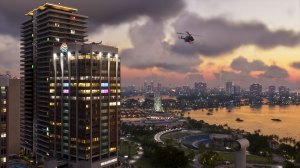


Atmospheric Realism: How GTA 6 is Redefining In-Game Weather
Rockstar Games is pushing the boundaries of open-world immersion with Grand Theft Auto 6, moving far beyond the static environmental effects seen in their previous titles. By completely overhauling their rendering engine, the studio is aiming to create a living, breathing version of Leonida that reacts to the player in unprecedented ways.
Engineering a Living Environment
Owen Shepherd, Rockstar’s Vice President of Art for Lighting and Rendering, recently shared insights into the technical evolution behind the game’s atmosphere. In a discussion with Game Informer, Shepherd explained that the team has fundamentally re-engineered their weather architecture. The primary objective was to move away from global weather states toward a system that is both persistent and highly localized.
This shift is designed to give the state of Leonida-a fictionalized interpretation of Florida-a sense of physical weight and massive scale that surpasses anything the studio has previously achieved. With the highly anticipated release date of November 19 approaching, these technical leaps are becoming a focal point for fans expecting a new benchmark in gaming fidelity.
The Science of Leonida’s Skies
To capture the unique meteorological personality of the Sunshine State, Rockstar is implementing several advanced features:
* Dynamic Cloudscapes: Rather than simple skybox textures, the game features volumetric, shifting cloud formations that traverse the map, creating varied lighting conditions across different regions simultaneously.
* Localized Precipitation: Mirroring the real-world Florida experience, players might find themselves driving through a sudden, intense downpour while the horizon remains bathed in clear, golden sunlight.
* Persistent Environmental Effects: The world now tracks moisture. After a storm passes, the environment retains a realistic sheen; roads will remain slick, and puddles will accumulate in low-lying areas, affecting vehicle handling and visual reflections.
* Atmospheric Wind Dynamics: The simulation extends to wind patterns, which now influence the environment in subtle ways, such as the introduction of cooling offshore breezes that pick up once the sun dips below the horizon.
Why This Matters for Immersion
In modern open-world design, the environment is often treated as a backdrop. However, by integrating features like rainbows that emerge from shifting light and humidity-driven weather patterns, Rockstar is treating the climate as a core gameplay element. This level of detail ensures that the world feels less like a digital map and more like a tangible, unpredictable ecosystem.