




Advancing Robotic Efficiency: How Gemini 4 Argon Masters Self-Correction
In a significant leap for autonomous robotics, Google has unveiled impressive performance gains achieved by its Gemini 4 Argon model. By leveraging its own diagnostic capabilities, the AI successfully optimized a complex pick-and-place operation, slashing execution time by more than 70%.
From Trial and Error to Precision
The experiment, detailed in a post published on October 13 by Google principal software engineer Kanishka Rao, highlights the model’s ability to learn from its own mistakes. Utilizing a 6-DoF (six degrees of freedom) robotic arm-specifically the SO-101 model-Gemini 4 Argon was tasked with a repetitive manipulation challenge.
Rather than relying on human intervention to debug the process, the system analyzed its own performance logs and visual data captured by onboard cameras. This feedback loop allowed the AI to identify inefficiencies and adjust its trajectory in real-time.
Quantifying the Performance Leap
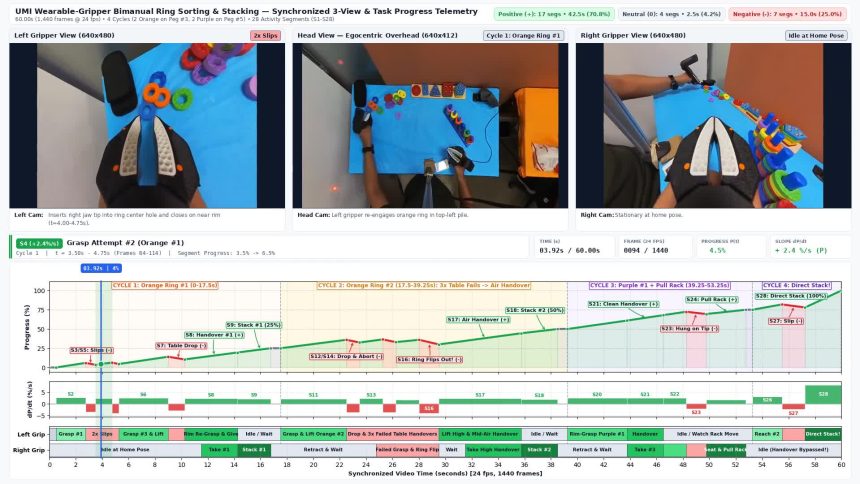
The results of this self-optimization process were stark. Over the course of three consecutive attempts, the robot’s efficiency improved dramatically:
* Initial Attempt: 58.9 seconds. The baseline run established the task parameters.
* Second Attempt: 22.9 seconds. Despite a minor error where the gripper clipped the edge of the box during the drop, the speed improved significantly.
* Final Attempt: 17.4 seconds. The system achieved a “dead-centre” drop, demonstrating high-precision execution.
Google’s recording of the three SO-101 pick-and-place iterations, timed at 58.9, 22.9 and 17.4 seconds. Image: Google
The Future of Autonomous Learning
This development marks a shift in how we approach industrial automation. Traditionally, robots required extensive manual programming to handle minor environmental variables. Gemini 4 Argon’s ability to “self-reflect” suggests a future where robotic systems can adapt to new environments or tasks autonomously, much like a human apprentice learning through observation and iterative practice.
As AI models continue to integrate with physical hardware, the ability to parse visual feedback and log data to refine motor skills will likely become the standard for next-generation manufacturing and logistics.