



STARVAULT: Why This VR MOBA Is the Genre-Defining Shooter You Need to Play
When STARVAULT first debuted on the Meta Quest platform in late 2025, it arrived with a bold claim: it was the virtual reality industry’s inaugural true first-person MOBA. Now that the title has officially expanded to SteamVR, it is clear that this isn’t just a marketing gimmick-it is a masterclass in genre fusion.
It is rare for a game to completely recalibrate your expectations, especially when you think you’ve already seen what it has to offer. During my initial sessions with the early access build, I walked away impressed by the technical polish and the clear ambition behind the project, yet I remained skeptical about its long-term appeal. Fast forward twelve months, and the reality is quite different: I have poured over thirty hours into the Steam version in a mere fortnight.
For someone who typically avoids the MOBA genre like the plague, this level of addiction is a testament to the design philosophy at Theia Games. They have successfully bridged the gap between high-octane hero shooters and tactical lane-based strategy, resulting in an experience that feels both fresh and essential.
Quick Specs: The Essential Details
- Genre: Strategic First-Person MOBA / Hero Shooter Hybrid
- Available On: Meta Quest, SteamVR
- Launch Timeline: November 27, 2025 (Quest); June 25, 2026 (Steam)
- Developer/Publisher: Theia Games
- Cost: Free-to-Play
Mastering the Battlefield: Strategy Over Reflexes
At its core, the objective of STARVAULT is straightforward: dismantle the opposing team’s base before they dismantle yours. However, beneath this simple premise lies a complex web of tactical choices. You aren’t just fighting; you are managing a battlefield. Your AI-controlled “Creeps” act as the heartbeat of the match, constantly marching down lanes to apply pressure and force the enemy to react.
The map is designed to reward those who explore beyond the primary lanes. Venturing into the “Jungle” areas allows players to secure buffs from neutral monsters, while dynamic, timed objectives can shift the tide of battle in an instant. The inclusion of portals adds a layer of vertical and spatial mobility that keeps the gameplay feeling fluid. Perhaps the most exhilarating feature is the Titan-a massive stone automaton that, once claimed, serves as a player-piloted siege engine capable of shattering even the most fortified defenses.
The “Hook”: Why STARVAULT Succeeds
What elevates STARVAULT above standard shooters is the intricate synergy between its systems. It is a constant, high-stakes balancing act. You must weigh the benefits of farming experience points against the necessity of supporting a teammate in a skirmish or securing a map objective.
While raw mechanical skill-your aim and movement-is certainly a factor, the matches are consistently won by the team that demonstrates superior decision-making. In the current competitive landscape, where many shooters prioritize twitch reflexes, STARVAULT stands out by emphasizing macro-strategy. Knowing when to retreat, which lane to prioritize, and when to sacrifice a minor objective for a
0:00 / 0:18
A showcase of the diverse character lineup in STARVAULT
Mastering the Meta: The STARVAULT Progression Loop
At its core, STARVAULT is defined by a sophisticated growth system that rewards players both in the heat of a single match and throughout their long-term journey. Whether you are clearing waves of minions, capturing strategic map points, or securing a takedown on an opposing player, every action feeds into a feedback loop of empowerment. As you accumulate experience and gold, you aren’t just getting stronger; you are actively sculpting your character to match your tactical preferences.
What sets this experience apart is the agency granted to the player. Character development is far from a passive “set it and forget it” affair. Instead, each session forces you to weigh your options: do you prioritize raw offensive power to snowball early, or do you invest in defensive utility to ensure you can survive late-game team fights? The synergy between the in-game shop and the ability upgrade tree ensures that even if you pick the same hero twice, your build path can result in a completely different tactical experience.
A Diverse Roster of Champions
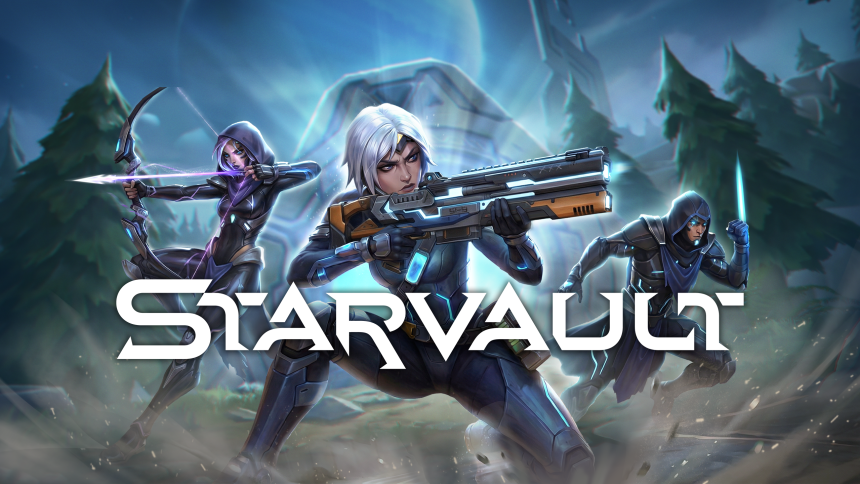
The true highlight of STARVAULT is its current lineup of fifteen distinct heroes. While the game adheres to the structural foundations of the MOBA genre, the actual moment-to-moment gameplay feels more akin to a high-octane hero shooter.
While the traditional “Tank, Support, and DPS” archetypes exist, they are merely starting points. The variety in movement and combat mechanics is staggering. You might find yourself piloting a fully autonomous drone, wielding high-tech blades as a stealthy assassin, or operating a heavy-duty mech that utilizes arm-swing locomotion-a mechanic that will feel instantly familiar to fans of Gorilla Tag.
The verticality of the maps further emphasizes this variety. One hero might utilize a high-tension grapple hook to secure a sniper’s nest on a rooftop, raining down destruction from above, while another might rely on acrobatic prowess, performing tactical backflips to close the distance and engage in chaotic, close-quarters combat. This level of mechanical diversity ensures that every player can find a champion that perfectly aligns with their preferred style of play.
Note: Gameplay footage captured on Quest 3.
Mastering the Arena: A Deep Dive into STARVAULT’s Hero Dynamics
The character design in STARVAULT is nothing short of a masterclass in variety. Whether you are controlling a high-mobility combatant darting across the map on a hoverboard or commanding a hulking frontline juggernaut equipped with a heavy-duty shield and axe, the gameplay experience remains distinct. Even when two heroes share a similar tactical role, their mechanical execution feels entirely unique, ensuring that no two playstyles ever feel like a carbon copy of the other.
What truly sets Theia Games apart is their commitment to competitive integrity. Achieving balance in a roster this diverse is a monumental task, yet they have succeeded in making every single hero feel viable. During my extensive sessions with the game, I never felt that any specific character was broken or overpowered, nor did I encounter any “filler” heroes that lacked a clear purpose. In the hands of a skilled player, any member of the roster can become a game-changing force on the battlefield.
Progression, Accessibility, and Fair Play
My experience with the game spanned both the Steam version-where I had immediate access to the full roster of fifteen heroes-and the Quest version, where I engaged with the standard progression system. Unlocking characters through gameplay requires a dedicated time investment, but it is a rewarding process that never feels predatory. STARVAULT strictly avoids pay-to-win pitfalls; while players have the option to use real currency to speed up their unlocks, it is entirely optional. Every hero is accessible through pure gameplay effort.
The onboarding experience has also seen significant improvements. The inclusion of a central hub world is a game-changer, allowing newcomers to test drive heroes in practice arenas, tutorials, and deathmatch simulations before spending their currency. This feature effectively lowers the barrier to entry, making the game’s inherent complexity much easier to digest for those just starting out.
Refining the Competitive Experience
If there is one area ripe for improvement, it is the pacing of matches. When two evenly matched teams clash, the result is often a grueling war of attrition. It is not uncommon for games to drag on for thirty to forty minutes, which can be a hurdle for gamers with limited schedules. Introducing a more compact map designed specifically for shorter, fifteen-to-twenty-minute bursts of action would be a fantastic addition, broadening the game’s appeal to those who need a quicker competitive fix.
Accessibility and Comfort Settings
STARVAULT offers robust comfort options to accommodate various playstyles. Users can play either seated or standing, with extensive settings for rotational vignettes and movement speed. Navigation is primarily handled through stick-based artificial locomotion or arm-swinging mechanics, with a single character option providing teleportation for those who prefer it.
A Thriving Ecosystem
A multiplayer title lives or dies by its community, and STARVAULT is currently in a very healthy state. Whether I logged in during a quiet afternoon or at the height of evening traffic, finding a match was never an issue. When human player counts dip, the AI bots serve as competent placeholders, providing a decent challenge even if they lack the nuanced communication of a human squad.
The competitive scene is equally vibrant, bolstered by frequent tournaments and cash-prize events that keep the high-level meta evolving. Furthermore, the matchmaking algorithm is remarkably polished. As a newcomer, I was consistently placed in lobbies with players of a similar skill level, which allowed me to grasp the game’s mechanics without being crushed by veterans. By prioritizing a smooth learning curve, STARVAULT stands out as one of the most welcoming competitive titles currently available in the VR space.
In-game action recorded via Steam
Visual Fidelity and Technical Performance
When evaluating the graphical prowess of STARVAULT, it is impossible to ignore how well it runs on Meta Quest hardware. The developers have crafted an expansive, multi-layered environment that emphasizes vertical movement, ensuring the map feels dynamic rather than static. The aesthetic choices prioritize clarity and readability, which is vital for a competitive MOBA-style shooter, ensuring that the game remains visually appealing without sacrificing frame rate stability. Whether playing on a standalone headset or via a high-end PC, the performance remains consistently smooth.
It is evident that the game was built from the ground up with mobile VR chipsets in mind. Consequently, the PC iteration functions more as a refined, higher-resolution version of the core experience rather than a complete graphical overhaul. Much like the design philosophy seen in titles such as Population: One, STARVAULT relies on a cohesive, stylized art direction that ages better than attempts at hyper-realism. Quest users will likely find the visuals stunning, while PC enthusiasts will appreciate the crispness and improved texture filtering that the extra hardware overhead provides.
Audio Engineering and Immersion
The soundscape in STARVAULT is functional, precise, and highly effective. In the heat of a frantic skirmish, the spatial audio implementation is a standout feature, enabling players to pinpoint the origin of incoming projectiles or ability activations with pinpoint accuracy. Each character is equipped with unique audio cues, which serve as essential feedback during team fights, allowing players to react to threats based on sound alone.
While it may not reach the cinematic, immersive heights of a tactical shooter like Breachers, the audio design is undeniably professional. It fulfills its primary purpose-providing the player with the necessary information to succeed-and contributes to a cohesive, high-quality atmosphere that feels polished from start to finish.
The Final Word: Why STARVAULT Is a Must-Play
My journey with STARVAULT has been a complete surprise. Initially, I approached the title with tempered expectations, anticipating a brief session before moving on to other projects. Instead, I found myself completely hooked. After spending over thirty hours in the game, it has firmly established itself as my go-to shooter, and I have no plans to put it down anytime soon.
The game’s success stems from a perfect storm of deep strategic mechanics, a diverse roster of heroes, and a thriving, active player base. While there are minor friction points-specifically, the occasional match length that can feel slightly overextended and the significant time investment required to unlock the full hero roster-these are small caveats in an otherwise stellar experience.
If you have even a passing interest in the competitive shooter genre, STARVAULT is an essential addition to your library. It is rare to find a title that captures your attention so thoroughly, and frankly, I would much rather be back in the arena right now than finishing this review. It is a rare gem in the current VR landscape that demands your attention.
Our publication utilizes a 5-Star scoring metric for all software evaluations. For a detailed explanation of our grading criteria, please consult our official review guidelines.