





Note: This review contains minor spoilers for a film released over five decades ago.
It is a strange coincidence how paths cross in the entertainment industry. Years ago, during my tenure as an editor for a publishing house specializing in comics and memorabilia, I crossed paths with author Gabe Essoe. He pitched a comprehensive guide to Tarzan collectibles; while we ultimately declined the project, it is surreal to find myself reviewing a film co-written by that very same man today. It is a small world, indeed.
When The Devil’s Rain first hit theaters, its marketing campaign boldly claimed it featured “the most incredible, unforgettable ending of any motion picture ever!” While that is classic 1970s promotional hyperbole, the film’s climax-a masterclass in practical effects-is genuinely etched into my memory. While the movie has cultivated a dedicated cult following, it has never quite ascended to the status of a cinematic masterpiece. Revisiting it through the lens of Severin Films’ stunning new 4K restoration, it becomes clear why: despite a stellar cast, gorgeous cinematography, and that iconic finale, the narrative lacks the cohesion required for greatness. Nevertheless, this time capsule of 1970s occult obsession-blending ESP, Satanism, and William Shatner-remains a fascinating watch.
The Occult Legacy of the Preston Clan
The plot centers on the Preston family, who have been under a centuries-old curse cast by the sinister cult leader Corbis, played with gravelly menace by Ernest Borgnine. The conflict stems from a historical betrayal: a former disciple absconded with Corbis’s registry of followers. These souls are now trapped within a vessel known as the “Devil’s Rain.” Corbis requires this book to finalize his pact with the underworld, allowing him to manifest these souls into living vessels or wax-like effigies-think of them as malevolent, supernatural voodoo dolls.
When the family matriarch, Emma (Ida Lupino), and her son Mark (William Shatner) vanish, the burden of rescue falls upon the younger brother, Dr. Tom Preston (Tom Skerritt), his clairvoyant wife Julie (Joan Prather), and their associate Dr. Sam Richards (Eddie Albert). As they venture into the heart of the cult’s territory, the film leans heavily into the era’s fascination with the paranormal. It is a quintessential 70s showdown, pitting rational science against ancient, dark mysticism.
A Stylistic Time Capsule
The film opens with a jarring, discordant score and unsettling imagery inspired by Hieronymus Bosch, immediately establishing a sense of dread. However, the immersion is occasionally broken by questionable casting choices-most notably, the decision to cast a 44-year-old William Shatner as the son of 57-year-old Ida Lupino. It is a stretch that requires significant suspension of disbelief.
The narrative structure is equally demanding, often dropping the audience into the middle of the action without providing necessary context. While some might view this as a flaw, it contributes to a pervasive, satisfying sense of bleakness. Visually, the film punches above its weight; despite a production quality that occasionally mirrors a made-for-TV movie, the cinematography captures haunting, desolate landscapes. The depiction of a windswept, abandoned western ghost town-populated by eyeless, cult-afflicted inhabitants-remains one of the most striking visual sequences in horror history.
The Verdict on 70s Satanic Cinema
In an era where horror was shifting from the gothic tropes of the 60s to the gritty, realistic terror of the late 70s, The Devil’s Rain
The Devil’s Rain: A Cult Horror Oddity Revisited
The imagery of black-robed acolytes stalking through a desolate, wind-swept town-reminiscent of the post-apocalyptic dread found in The Omega Man-remains a striking visual, even if the inclusion of a literal tumbleweed feels a bit heavy-handed. Thankfully, the production avoided the cliché of naming the setting “Purgatory,” settling instead for the slightly more grounded moniker of Redstone.
A Masterclass in Menace and Practical Effects
Ernest Borgnine delivers a performance dripping with genuine hostility. His interactions with William Shatner and Eddie Albert possess the high-stakes, theatrical tension one might expect from a classic Bond villain. The musical score, composed by Al De Lory, echoes the dissonant, unsettling tones Leonard Rosenman brought to Beneath the Planet of the Apes. The film makes ambitious, if occasionally uneven, attempts at thematic depth, most notably in a sequence where a torrential downpour serves as a biblical manifestation of divine retribution, echoing the supernatural intensity seen in the climax of Raiders of the Lost Ark.
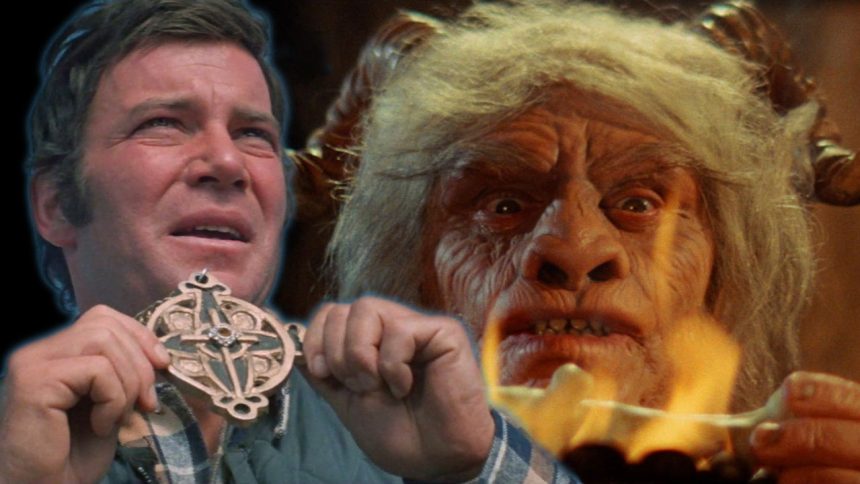
However, the true technical achievement lies in the makeup artistry of Tom and Ellis Burman Jr. From Borgnine’s transformation into a horned, goat-like entity to the grotesque, multi-colored liquefaction of the cultists during the finale, the practical effects are visceral. While the high-definition era has made the black eye-plugs worn by the disciples somewhat obvious, the aesthetic remains undeniably iconic.
!Ernest Borgnine as Corbis in The Devil’s Rain
Academy Award winner Ernest Borgnine fully embraced the campy intensity required to play the villainous Corbis.
The Shatner Connection and the Birth of a Horror Icon
Addressing the William Shatner factor is essential: he exercises surprising restraint here, despite his screen time being largely confined to the first act and the final moments. He even offers a precursor to his legendary “Khan!” scream, bellowing “Corbissssss!” toward the heavens, and mirrors Charlton Heston’s shirtless bravado from The Omega Man.
Beyond the performance, the film holds a unique place in horror history. The lifecast created for Shatner’s face during production was later acquired by Don Post Studios to manufacture the 1975 Captain Kirk mask. As horror lore dictates, this mask was eventually repurposed by the production team of John Carpenter’s Halloween to create the blank, emotionless face of Michael Myers. While Shatner has historically been coy about this connection, there is a hidden detail often overlooked by film historians: Shatner actually pioneered the “Myers head tilt.” In a late-film sequence where a transformed, eyeless Shatner attempts to recognize his brother, he executes that exact, inquisitive tilt-three years before Nick Castle would make it a staple of the slasher genre.
Missed Potential and Narrative Missteps
While The Devil’s Rain succeeds as a piece of ambitious cult cinema, it is hampered by a narrow, dated perspective. The film’s biggest narrative failure is its focus on Tom Skerritt’s character, who remains largely passive and uninteresting throughout the ordeal.
The story would have been significantly more compelling had it centered on Julie. As an outsider, her journey of discovery would have provided a much stronger emotional anchor for the audience. Furthermore, the sepia-toned psychic flashback to 1680-a sequence that depicts the origins of the curse-would have carried much more weight had Corbis acknowledged her presence during that vision. Had the script leaned into her perspective, The Devil’s Rain might have transcended its status as a mid-tier cult curiosity to become a definitive pillar of 1970
Revisiting The Devil’s Rain: A Cult Classic’s 4K Resurrection
While The Devil’s Rain often struggles to find its footing, it remains a fascinating artifact of 1970s occult cinema. The film is anchored by Joan Prather’s committed performance, and while the narrative pacing can be uneven, the production builds toward a climactic sequence so visually arresting that it almost justifies the preceding slog. It is a movie that clearly aspires to greatness, even if it frequently falls short of its own ambitions.
A Legacy of Cinematic Connections
For modern horror enthusiasts, the appeal of The Devil’s Rain lies in its strange position within the genre’s lineage. It serves as a connective tissue between various eras of horror, sharing DNA with atmospheric classics like The Haunted Palace and the eerie dread of The Touch of Satan. Sharp-eyed viewers might even spot stylistic echoes that seem to prefigure the surrealism of Lucio Fulci’s The Beyond or the iconic imagery found in A Nightmare on Elm Street. Even the desert-set finale carries a visual weight that feels like a precursor to the Tatooine sequences in Return of the Jedi. While it may not be a perfect film, it possesses a distinct personality that makes it a compelling watch for those who appreciate the “what could have been” nature of cult cinema.
Deep Dive: The 4K Bonus Suite
Severin Films has packed this 4K UHD/Blu-ray combo with an exhaustive collection of supplemental material, largely carried over from their 2017 release. These features provide a fascinating “behind-the-curtain” look at a production that was as chaotic as the film itself.
- The Makeup Magic: Legendary artist Tom Burman offers candid insights, including the persistent industry rumor that the film was bankrolled by Mafia interests. He also provides a humorous, if biting, assessment of William Shatner’s legendary ego.
- The Travolta Connection: Perhaps the most bizarre historical footnote is the involvement of Anton LaVey, founder of the Church of Satan, who served as a technical advisor. The extras detail his unexpected bond with a young John Travolta, who made his screen debut here. Interestingly, it was co-star Joan Prather who introduced Travolta to Dianetics, adding a layer of real-world irony to the film’s occult themes.
- Commentary Tracks: The release includes two distinct audio commentaries. Director Robert Fuest provides a grounded, technical perspective, while the 2026 addition features film historian Stephen R. Bissette. While Bissette’s track is dense with trivia, his recurring mispronunciation of the production house “Bryanston” serves as a minor, albeit amusing, distraction for eagle-eared listeners.
Beyond these highlights, the package is rounded out with extensive photo galleries, vintage radio spots, and the original theatrical trailer, making it a comprehensive archive for completionists.
Final Verdict
Severin Films has done a remarkable job with this 4K restoration, breathing new life into a film that is undeniably flawed but undeniably unique. The cast-which includes heavy hitters like Tom Skerritt and Ida Lupino-often feels like they are operating in a different, superior movie than the one they were actually cast in. While The Devil’s Rain is unlikely to be remembered as a masterpiece of the genre, it stands as a quintessential example of 1970s Satanic panic cinema. It is a frustrating, occasionally silly, yet deeply intriguing experience that, thanks to this high-quality release, finally gets the context it deserves.