




Illuminating the Night: Reflect Orbital’s Space Mirror Project Faces Regulatory and Scientific Scrutiny
The concept of “daylight on demand” is moving from science fiction to reality. Reflect Orbital, a California-based startup, has secured official authorization from the U.S. Federal Communications Commission (FCC) to deploy a prototype satellite designed to beam sunlight back to Earth during nighttime hours. While the company frames this as a breakthrough for global productivity, the project has ignited a firestorm of debate regarding the preservation of our night skies.
The Mechanics of Eärendil-1
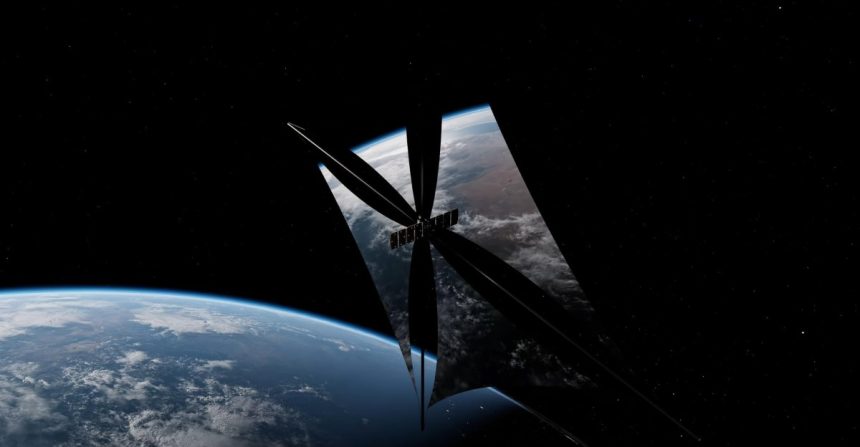
The upcoming mission, dubbed Eärendil-1, will utilize a massive 59-foot (18-meter) reflective membrane to capture solar rays and redirect them toward specific coordinates on the planet’s surface. This initial launch serves as a proof-of-concept for a much more ambitious roadmap: Reflect Orbital aims to establish a massive constellation of 50,000 satellites by 2035.
If fully realized, this network would be capable of illuminating 3-mile (5-kilometer) patches of land on command. The company envisions a future where this technology serves as a utility, offering:
* Enhanced Emergency Response: Providing instant, natural illumination for search-and-rescue operations in remote or disaster-stricken areas.
* Agricultural Efficiency: Extending the growing season or allowing for nighttime harvesting without the need for energy-intensive artificial lighting.
* Sustainable Infrastructure: Reducing the reliance on carbon-heavy street lighting by utilizing reflected solar energy.
The Existential Threat to Astronomy
Despite the potential utility, the project has met significant resistance. The FCC’s decision to grant the license followed a contentious period during which nearly 2,000 public comments were filed in opposition.
Leading scientific organizations, including the American Astronomical Society, the Royal Astronomical Society, and DarkSky International, have voiced grave concerns. The primary issue is light pollution; by introducing artificial, high-intensity light sources into the night sky, these satellites threaten to obscure the view for ground-based observatories.
“For optical astronomy, this is an existential threat,” noted Betty Kioko of the European Southern Observatory. The concern is that the constant presence of these mirrors will create “noise” in the data collected by telescopes, potentially rendering deep-space observations impossible.
Beyond the Telescope: Ecological and Aviation Risks
The debate extends beyond the scientific community. Critics are highlighting two major areas of concern that remain largely unaddressed:
- Disruption of Biological Rhythms: Many nocturnal species rely on the natural cycle of darkness to hunt, navigate, and mate. The introduction of artificial “sunlight” at night could have cascading effects on local ecosystems and biodiversity