


Transforming Concepts into Software: The Rise of Conversational Development
The landscape of software creation has shifted dramatically, moving away from complex syntax toward intuitive, conversational interfaces. Today, virtually any sophisticated AI chatbot serves as a gateway for users to engage in vibe coding. Whether you are looking to deploy functional event calendars or recreate video game demakes, the barrier to entry has effectively vanished. By simply articulating your vision, these models translate intent into executable code. While Google’s Gemini remains a reliable workhorse for these tasks, Google is also actively diversifying its portfolio with experimental platforms designed to streamline web-based innovation.
Exploring Google’s Experimental Frontier: The Opal Platform
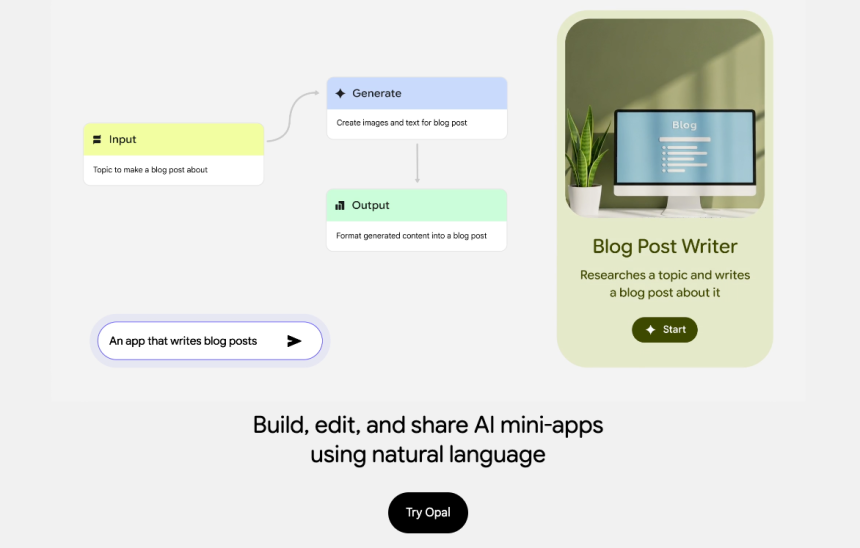
Among these specialized initiatives is Opal, a project that pushes the boundaries of generative development. Unlike standard chatbots that provide a block of code for you to copy and paste, Opal functions as a dedicated no-code environment. It interprets natural language prompts to architect applications, providing a visual interface that maps out the logic flow through a series of interconnected “nodes.”
The Reality of AI-Driven App Construction
While the promise of “building by speaking” is compelling, it is important to manage expectations. Current industry data suggests that while AI-assisted development can reduce initial prototyping time by up to 40%, experimental tools like Opal are still in their infancy.
The node-based visual editor offers a unique perspective on how data moves through an application, which is excellent for educational purposes or rapid iteration. However, because it is an experimental build, the learning curve is steeper than that of a standard chat interface. It is a powerful utility for those willing to navigate its quirks, but it currently serves as a glimpse into the future of development rather than a polished, enterprise-ready solution. As the technology matures, we can expect these visual logic flows to become the standard for non-technical creators looking to bring their digital ideas to life.