




Market Calmness Persists: Why Volatility Is Retreating Across Crypto and TradFi
Updated 1 hour ago | Published 2 hours ago
This analysis is an excerpt from the CoinDesk ‘Daybook’ newsletter. Sign up here to receive daily market insights.
Despite a global landscape fraught with geopolitical friction-ranging from the persistent threat of U.S.-Iran conflict to the looming pressures of ballooning sovereign debt and climbing bond yields-financial markets are exhibiting a surprising degree of tranquility. Whether you look at traditional assets or the digital currency space, the prevailing sentiment is one of unexpected composure.
The “Fear Gauge” Signals Stability
To understand this disconnect between headline risks and market behavior, we look to implied volatility. This metric serves as a barometer for expected price turbulence, derived from the pricing of options and derivatives that investors use to hedge against sudden, chaotic market shifts.
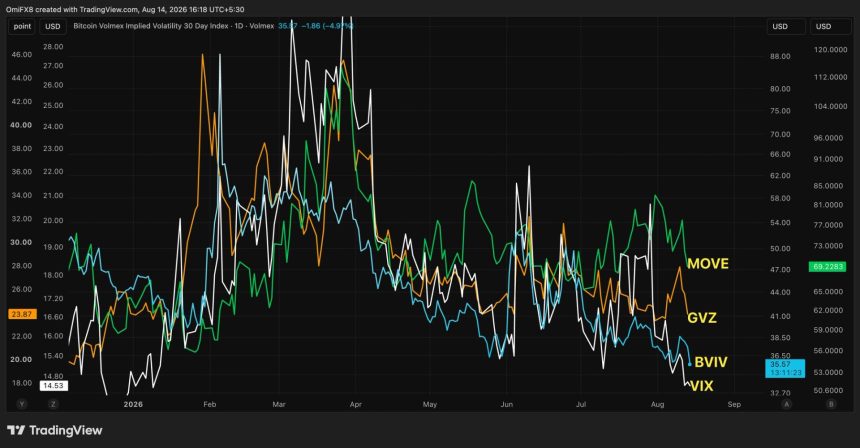
Currently, the data suggests that traders are largely unbothered. For instance, the S&P 500’s “fear gauge,” the VIX index, has retreated to its lowest point since January. This decline indicates that institutional investors are currently prioritizing stability over aggressive hedging, even as macroeconomic headwinds persist.
Crypto Markets Follow Suit
The digital asset sector is mirroring this trend of cooling expectations. Bitcoin’s 30-day implied volatility index (BVIV) has recently dipped toward 36%, hitting a 2026 low. This marks a reversal from the slight uptick to 38% observed earlier in the week. Ether, the second-largest cryptocurrency by market capitalization, is experiencing a similar contraction in volatility.
This calm is notable given that the crypto industry is still navigating its own unique set of hurdles, including:
* Regulatory Uncertainty: Ongoing shifts in legal frameworks that continue to challenge market participants.
* Demand Fluctuations: Periods of tepid retail and institutional interest that can lead to liquidity gaps.
* Security Vulnerabilities: The ever-present risk of protocol exploits and exchange hacks.
Why the Disconnect?
It is a paradox: why would markets remain so sanguine when the geopolitical and fiscal outlook remains so complex? One theory is that investors have become desensitized to “perpetual crisis” narratives. Much like a driver who stops noticing the sound of a rattling engine after months of neglect, the market may be pricing in these risks as the “new normal” rather than as catalysts for immediate panic.
As we move through the second half of 2026, the lack of volatility suggests that while the risks are acknowledged, they are not currently viewed as imminent threats to the broader financial structure.