





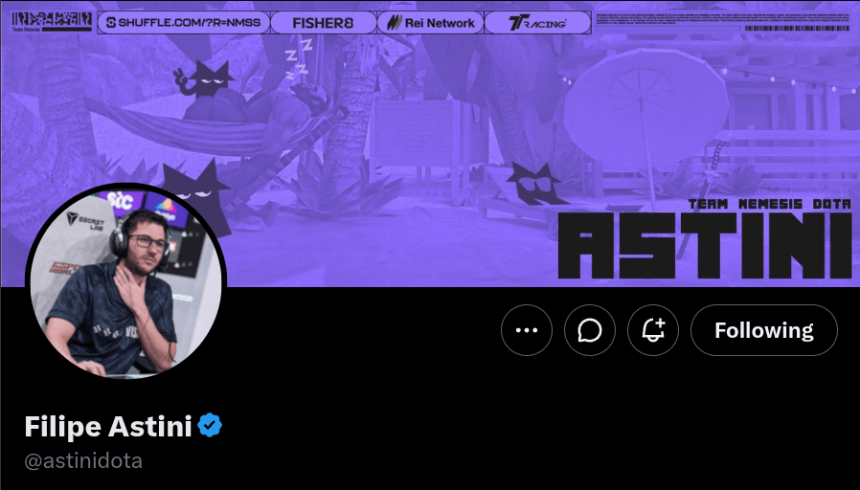
The Crusade Against Integrity Breaches: Astini’s Fight for Fair Play in Dota 2
Filipe “Astini” Ribeiro has emerged as a vocal watchdog within the Dota 2 professional scene, dedicating significant energy to exposing illicit activities. His campaign gained substantial momentum following the high-profile disqualification of Santiago “TaiLung” Agüero Gustavo from PGL-sanctioned tournaments. This incident served as a catalyst for Astini to broaden his scope, shifting his focus from individual cheaters to the systemic issue of match-fixing that has plagued the North and South American competitive circuits.
A Retrospective on Astini’s 2026 Advocacy
Throughout 2026, Astini has utilized his platform to pull back the curtain on the darker side of professional Dota 2. His commentary on the TaiLung ban was particularly pointed, framing it not as an isolated event, but as a symptom of a deeper rot within the regional ecosystem. By analyzing his public statements and the subsequent community discourse, it becomes clear that fans are increasingly polarized; while many applaud his transparency, others remain skeptical of the industry’s ability to self-regulate. The conversation surrounding his tweets highlights a growing demand for accountability in a scene where trust has become a scarce commodity.
Securing the Esports World Cup Qualifiers
The intensity of Astini’s efforts reached a boiling point during the 2026 Esports World Cup (EWC) Regional Qualifiers. During this period, he raised alarms regarding widespread cheating, suggesting that the competitive landscape was being compromised by players utilizing unauthorized software and external assistance. To combat this, Astini lobbied tournament organizers to implement a secure, private Discord server for participants. This measure was designed to act as a digital fortress, ensuring that communication and gameplay remained untainted by outside interference.
This proactive approach mirrors the security protocols seen in other high-stakes esports, such as the stringent anti-cheat measures implemented in professional Valorant or CS2 tournaments, where isolated environments are now the industry standard. By pushing for these structural changes, Astini is attempting to shift the burden of integrity from the players to the organizers, creating a more robust framework for future competitions.