





Sword Sage: Awakening: A Fresh Take on Soulslike Combat
The global gaming landscape is currently witnessing a massive surge in high-quality action-RPGs emerging from China. Following the monumental impact of Black Myth: Wukong and the growing anticipation surrounding Phantom Blade Zero, a new title is demanding attention: Sword Sage: Awakening. During a recent hands-on session at the BiliBili Game First Look showcase in Shanghai, I had the opportunity to test this upcoming project from indie developer Sword Panda. While the game shares DNA with the Soulslike genre, it introduces a distinct, Bruce Lee-inspired combat philosophy that challenged my muscle memory and forced me to rethink how I approach virtual duels.
Rethinking the Soulslike Formula
To be transparent, I don’t claim to be a master of the genre. While I have spent time with titles like Sekiro: Shadows Die Twice and Lies of P, and successfully conquered Elden Ring-largely thanks to the flexibility of its open-world design-I am accustomed to the standard rhythm of these games. Typically, the gameplay loop involves a heavy reliance on dodge-rolling to avoid damage, waiting for a brief opening to strike, and repeating the process. Sword Sage: Awakening, however, completely disrupts this established cadence.
The Philosophy of the Intercepting Blade
The most jarring adjustment for any veteran player is the total absence of a dodge-roll button. My thumb spent the first thirty minutes of my two-hour demo frantically searching for an evasive maneuver that simply doesn’t exist. Furthermore, there is no dedicated parry button. Instead, Sword Panda has integrated the principles of Jeet Kune Do-the martial art founded by Bruce Lee-into the core mechanics. The central tenet of this style is the “way of the intercepting fist,” which posits that the most effective moment to strike is the exact instant your opponent begins their offensive.
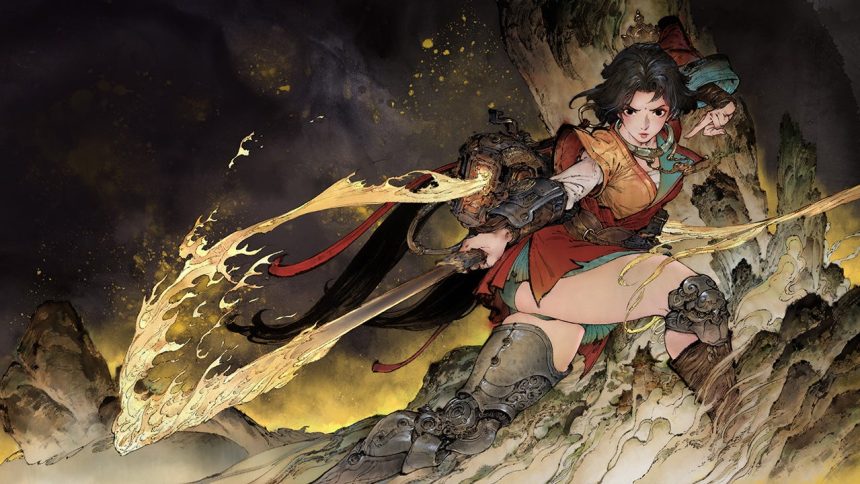
In Sword Sage, this translates to a high-stakes dance of precision. Rather than rolling away, you must analyze the enemy’s posture and execute an “evading counter.” By holding the block button and flicking the right thumbstick in the direction of the incoming strike-up for high attacks, down for low, and laterally for mid-section blows-you can neutralize the threat. Successfully timing these directional inputs creates a window to shatter the enemy’s guard, allowing for devastating combos or weapon-specific special moves.
Weapon Management and Strategic Depth
While you can opt to block attacks directly with your blade, this is a risky strategy. Standard blocks degrade your weapon’s durability. If your blade shatters, you are forced to swap to a secondary weapon while the primary one undergoes a cooldown period in the heroine’s shoulder-mounted weapon chest. This mechanic emphasizes the developers’ mantra: “evade the steel and return for scarlet.” The goal is to avoid damage entirely through fluid movement and counter-strikes, ensuring your blade remains sharp and your opponent remains bleeding.
Familiar Foundations in a New World
Despite its innovative combat, the game’s world design will feel comforting to fans of FromSoftware’s catalog. The level architecture is intricate, featuring winding paths that loop back on themselves, allowing players to unlock shortcuts, drop ladders, and bypass dangerous enemy clusters. The game’s equivalent of “bonfires” are charming tree-stump benches. Here, you are greeted by a friendly red panda who serves tea to restore your health and provides a crafting interface for creating combat-enhancing consumables. By blending traditional level design with a revolutionary, rhythm-based combat system, Sword Sage: Awakening is shaping up to be a standout entry in the modern action-RPG scene
Mastering the Blade: A Deep Dive into Sword Sage: Awakening
The world of Sword Sage: Awakening is designed to keep you perpetually off-balance, masterfully blending moments of triumph with sudden, humbling defeats. Much like the classic “FromSoftware trap,” the game frequently baits you into pursuing a stealth kill on a distracted guard, only to have a hidden assailant ambush you from your blind spot. Beyond these calculated ambushes, the environment is populated by optional, high-level adversaries who stand perfectly still, radiating a quiet, menacing confidence that serves as a clear warning: engage at your own peril.
A Living, Breathing World
Beyond the constant threat of combat, the game world feels remarkably dynamic. Exploration is rewarded with environmental puzzles, such as locked treasure chests that require you to track down specific glyphs hidden throughout the map. Furthermore, the game features emergent gameplay where rival factions clash in the wild. These skirmishes provide players with strategic choices-you can observe from the shadows, slip past unnoticed, or intervene to secure valuable crafting materials from the aftermath. These incidental interactions breathe life into the setting, ensuring the world feels like a functional ecosystem rather than a static stage waiting for the player’s arrival.
Top-Tier Soulslike Experiences
If you enjoy the high-stakes tension of Sword Sage, you may also want to explore other titles in the genre that define the “Soulslike” experience.
Refining the Art of Combat
The core of Sword Sage: Awakening lies in its intricate combat mechanics. Mastering the evade and counter system is a steep learning curve, particularly during boss encounters that feature unblockable attacks. Initially, the game provides visual cues for these strikes in the form of Chinese characters, which can be difficult to decipher in the heat of battle. Fortunately, the developers have confirmed that the final release will include an option to toggle these to more intuitive directional arrows, making the system more accessible to a global audience.
When the combat clicks, however, it is nothing short of exhilarating. During my session, I eventually found a rhythm against a hulking demon boss, learning to predict its heavy, telegraphed swings while systematically whittling down its massive health pool. While I ultimately fell during the second phase of the fight, the experience felt like a genuine progression of skill rather than an unfair wall.
Accessibility Meets Challenge
While Sword Sage: Awakening wears its Soulslike difficulty on its sleeve, it avoids the rigid “git gud” philosophy often associated with the genre. Developer Sword Panda has implemented a clever, optional system for players who find the combat overwhelming.
The game maintains a single, unified difficulty setting, but it introduces a “safety net” mechanic. After suffering three deaths, players are granted access to two unique talismans. One simplifies the counter-timing by allowing for omnidirectional inputs, while the other enables automatic counters simply by holding the block button. These are not permanent crutches; they function like any other piece of equipment and can be unequipped at any time. This allows players to toggle these assists on for a particularly grueling encounter and remove them once they feel confident enough to tackle the game’s challenges in their raw, intended form.
During my final hands-on session, I utilized the auto-evade talisman to overcome the demo’s climactic boss. Even with the assistance, the fight remained deeply satisfying, largely due to the cinematic, Crouching Tiger, Hidden Dragon-inspired choreography that makes every exchange feel impactful. Whether I will rely on these tools in the full release remains to be seen, but the inclusion of such flexible design is a welcome evolution for the genre.
Broadening the Horizon: Making Sword Sage Accessible
While I am a staunch advocate for high-difficulty gaming experiences, I genuinely admire the steps Sword Panda has taken to ensure the intricate combat mechanics of Sword Sage: Awakening remain welcoming to a wider audience. By implementing thoughtful accessibility features, the developers have successfully lowered the barrier to entry without sacrificing the depth that makes the swordplay so compelling.
What to Expect from the Full Experience
There is still a significant amount of mystery surrounding the final iteration of Sword Sage: Awakening. Current projections suggest that the completed narrative campaign will offer roughly 15 hours of gameplay. Beyond the core story, the title promises an extensive suite of weapon customization options and a diverse array of arcane abilities, allowing players to fine-tune their combat approach to suit their personal preferences. Unfortunately, I didn’t have the opportunity to fully explore these systems during my initial preview, but they appear to be the backbone of the game’s replayability.
Development Status and Future Outlook
As of now, there is no official launch date on the horizon. The development team has indicated that the project is currently hovering around the 60% completion mark. This status was reflected in my hands-on session, where the PC build exhibited some noticeable technical hiccups and performance instability. Given the current state of production, it is highly probable that we won’t see a full release until sometime next year.
Despite the rough edges inherent in an unfinished build, my time with the game has left a strong impression. Sword Sage: Awakening is shaping up to be a standout action-RPG, and it is certainly a title that I intend to keep on my radar as it nears completion.
Tristan Ogilvie serves as a senior video editor at IGN’s Sydney branch. He participated in the BiliBili Game First Look event as a guest of the organizers.