

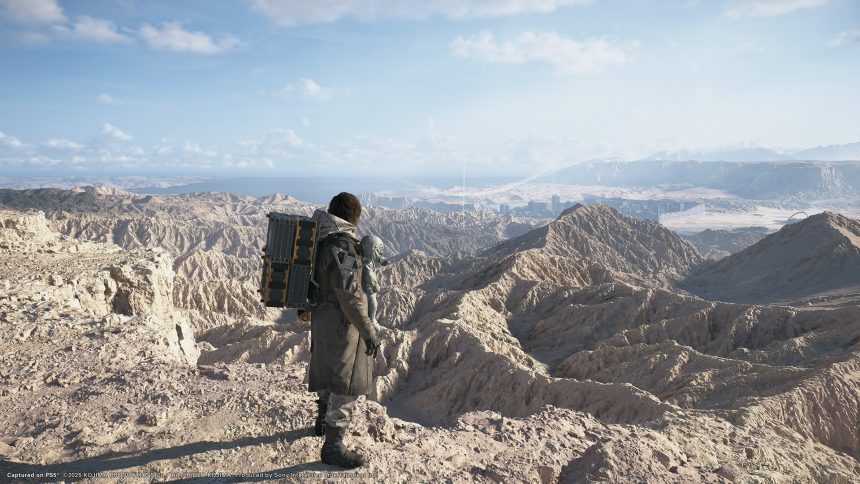

Why Death Stranding 2 Remains a Cult Phenomenon Rather Than a Mainstream Titan
When we first stepped back into the shoes of Sam Porter Bridges for an odyssey that arguably eclipsed its predecessor in scale and ambition, it was immediately clear that Death Stranding 2 was a singular achievement. Securing our Game of the Year title for 2025 wasn’t a decision made lightly; it was a recognition of Hideo Kojima’s uncompromising creative direction. By blending a surreal, high-concept narrative with a meditative, slow-burn gameplay loop, the title delivered an experience that was as visually arresting as it was compulsively playable.
With a dedicated player base of over two million, the game has carved out a loyal following in a crowded market. Yet, when you weigh the massive production budget, the star-studded cast-featuring Norman Reedus, Léa Seydoux, and Elle Fanning-and the prestige of being a PlayStation exclusive, the conversation shifts. While these figures are impressive for an indie title, they invite scrutiny when compared to the industry’s biggest blockbusters. Why does a game with such immense resources feel like a niche masterpiece rather than a universal household name?
Analyzing the Sales Paradox
To understand the disconnect, we must look at the data. Reaching the two-million-unit milestone-split between roughly 425,000 Steam sales and 1.6 million on the PlayStation 5-is a respectable feat. However, in the context of a “AAA” project backed by Sony’s marketing machine and the legendary status of Kojima Productions, these numbers suggest a ceiling that the game struggled to break through.
Consider the investment: this was a premium, high-fidelity production that demanded significant resources. While the game was highly anticipated, the sheer weight of expectation may have worked against it. The marketing campaign promised a revolutionary experience, but the final product’s idiosyncratic nature meant it was never destined to have the broad, pick-up-and-play appeal of a title like God of War or Spider-Man.
The “Cultural Icon” Trap
Death Stranding 2 occupies a strange space in the gaming zeitgeist. It is a game that is discussed, memed, and analyzed by millions who may have never even touched a controller to play it. Its trailers are treated like cinematic events, and Kojima’s auteur status ensures that every update is dissected with the intensity of a film festival premiere.
This creates a unique phenomenon: the game has achieved massive cultural relevance without achieving equivalent mass-market penetration. It is a “famous” game, but fame does not always equate to sales. Much like an avant-garde film that dominates the conversation at awards season but struggles at the box office, Death Stranding 2 is a victim of its own high-concept identity. It is a game that demands patience and intellectual engagement, qualities that often clash with the “instant gratification” model that drives the highest-selling franchises in the industry today.
Beyond the Mainstream
Ultimately, the “niche” label isn’t a slight against the game’s quality
The Paradox of Prestige: Why Niche Masterpieces Defy Traditional Success Metrics
In the modern gaming landscape, certain titles arrive with an inherent “prestige” that guarantees a baseline of public interest. Take Marvel’s Spider-Man, for instance; it combined the universal allure of superhero power fantasies with the high-production polish expected of a blockbuster. Similarly, Ghost of Tsushima leveraged the storied reputation of Sucker Punch Productions alongside a compelling samurai narrative, while The Last of Us utilized its narrative depth to transcend the medium, a status further cemented by its highly accessible television adaptation.
Then, there is the case of Death Stranding. While it certainly carried the weight of Hideo Kojima’s legendary status-a name that acts as a beacon for industry observers-it was never designed for mass-market consumption. The game demands a specific type of patience and a willingness to embrace friction. It is a brilliant, singular vision, but it is fundamentally polarizing. This distinction is critical: Kojima’s name is not a magic wand that guarantees universal appeal. While his involvement generates immense hype and positions a title as a “cultural event,” it cannot force a complex, avant-garde concept into the mainstream mold.
The Kojima brand can certainly drive trailer views and spark intense critical discourse, but once the controller is in the player’s hands, the reality of the experience sets in. The gameplay is methodical, deliberate, and intentionally slow. Consequently, many potential players end up admiring the game’s ambition from afar, never fully immersing themselves in the profound, layered emotional journey it provides.
Respected, Yet Polarizing: The Case for the “Difficult” Game
One might question why a title with such high barriers to entry would be crowned “Game of the Year.” The answer lies in the often-ignored nuance that a game’s artistic merit is not strictly tethered to its commercial reach. When a title is as unconventional and demanding as DS2, its value is found in its refusal to compromise.
DS2 functions much like its protagonists: it requires the player to exhibit resilience in the face of adversity. While the game is undeniably beautiful, technically refined, and emotionally heavy, it possesses inherent limitations. It is a sequel to a title that already divided audiences, and its core premise lacks the immediate, accessible hook of a caped crusader or a historical warrior. For those seeking a straightforward narrative or fast-paced action, the philosophical weight and meditative gameplay loop may feel like obstacles. Yet, these very “flaws” are the pillars of its identity. They define the experience, even if they simultaneously restrict its audience to those willing to meet the game on its own terms.
Furthermore, we must contextualize commercial performance. The original Death Stranding reached five million units sold by early 2021, but this was the result of a long-tail strategy. It benefited from years of sustained conversation, multiple price drops, a Director’s Cut re-release, inclusion in subscription services, and a delayed PC port. To judge DS2 solely on its initial launch window is to ignore how these types of prestige titles actually function in the market. They are “slow burns” that rely on word-of-mouth, curiosity, and eventual accessibility to build their legacy.
While DS2 may never reach the explosive, immediate sales figures of a mainstream blockbuster, it serves a different purpose: it is a long-term prestige asset. This is where the broader PlayStation strategy becomes clear.
The PlayStation Strategy: Balancing Blockbusters and Art-House
Sony’s overarching philosophy for the PlayStation brand has long been centered on high-fidelity, cinematic, single-player experiences. This strategy has been incredibly lucrative, establishing a reputation for quality that keeps players invested in the in the past and recent present, and will probably continue to do so in the near future.
DS2 stands out in that regard, though. It’s a prestige project to be sure, but it’s one that doesn’t come with a broadly accepted fantasy, the appeal of a familiar genre, or mass-market characters. It does carry a unique, auteur-driven identity that lets it stand out from other titles that fall into one or more of the other categories, though.
That doesn’t rule out its chances of achieving commercial success on the level of those titles over the course of its shelf life, and it’s not a bad investment despite not having the same commercial ceiling. It does, however, cement PlayStation as a home for ambitious creators who come with a vision for something that hasn’t been done before.
It’s proof that its unique form of prestige might not be as commercially well-performing, and it proves that not every critically acclaimed game is going to be a tentpole for the PlayStation brand, even if it’s one that became an internet sensation and a source of a lot of discussion around it. The intensity of its online presence seems to have distorted expectations around its scope and scale, in a way that has made it seem like it should have sold more than it has, despite the actual game being attractive to a relatively narrow buying audience.
But that still isn’t bad news for Kojima Productions, as a successful cult game is probably the best thing to happen for the studio. It has never needed to chase the largest possible audience it can get, but has definitely shown the intent to be a studio that makes games nobody else can make.
DS2’s devoted audience, and its rare creative identity courtesy of its makers, are factors that are more crucial in the examination of its overall success. Its sales numbers pale in significance to its avoidance of trying to be a mainstream blockbuster. It never tried to be one, and we think that it’s high time the industry and the game’s fans acknowledge that facet of its existence.
From that perspective, DS2 is a reality check, and should be seen that way as opposed to thinking about it as a disappointment. It isn’t Spider-Man, or Horizon Forbidden West, and that’s the point. It’s a title that has all the makings of a blockbuster, but one that is a lot more specific and focused on a vision that’s decidedly stranger and more fragile.
It’s what has made it sell like a successful cult game, and is certainly what it was always meant to be.
Note: The views expressed in this article are those of the author and do not necessarily represent the views of, and should not be attributed to, GamingBolt as an organizatio