





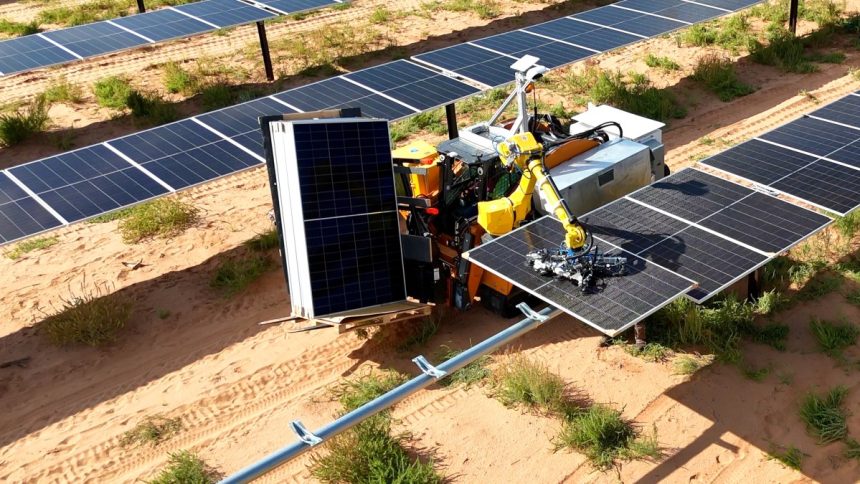
The Automation Revolution: Solving the Solar Labor Crisis
The global transition toward renewable energy is currently one of the most significant industrial shifts in history. Nations and private enterprises are aggressively scaling up solar power and battery storage infrastructure, driven by the dual imperatives of achieving energy sovereignty and mitigating the escalating impacts of climate change. However, this rapid expansion is hitting a major bottleneck: a severe shortage of skilled labor capable of keeping pace with the surging demand for installations.
While the construction sector has long looked toward robotics for efficiency, traditional industrial machines have historically faltered when faced with the unpredictable, messy, and ever-changing nature of outdoor job sites. Fortunately, the landscape is shifting. The emergence of sophisticated AI models is finally providing the “brainpower” necessary for robots to navigate and operate effectively in these unstructured environments.
Enter Gritt: Bridging the Infrastructure Gap
This technological convergence is the foundation of Gritt, a robotics startup established by Carnegie Mellon alumni Puneet Puri (CEO) and Vishal Dugar (CTO). The company officially emerged from stealth mode this Tuesday, announcing a successful $26 million Series A funding round. Led by Obvious Ventures, with additional backing from Union Square Ventures and Active Impact Investment, this latest injection of capital brings Gritt’s total funding to $34 million. Previous support came from a robust group of investors, including First Round Capital, Climactic, Congruent Ventures, and VSC Ventures.
Gritt’s mission is ambitious: to develop an intelligent, autonomous system designed to accelerate the construction of critical infrastructure. As Puri explains, the company’s core philosophy is rooted in the necessity of speed; if society intends to meet its climate goals, the pace of physical construction must be fundamentally reimagined.
Why AI-Driven Robotics Matter Now
The urgency for this technology is backed by data. According to recent industry reports, the solar sector faces a projected shortfall of hundreds of thousands of qualified technicians over the next decade. By deploying AI-integrated robots, companies like Gritt aim to augment the existing workforce rather than replace it, allowing human teams to focus on complex oversight while machines handle the repetitive, physically demanding tasks of solar array assembly.
Think of it like the transition from manual drafting to Computer-Aided Design (CAD); just as software revolutionized how we design buildings, AI-powered robotics are poised to revolutionize how we physically assemble them. By automating the heavy lifting and precise positioning required for solar panels, Gritt is positioning itself to be a cornerstone of the green energy transition.

![[UPDATE] Halloween: The Game Patches Out Sex Minigame — Dev Confirms ‘Major Oversight’](https://www.mixtv1.com/wp-content/uploads/2026/09/29039-attachment-scaled.jpg)