


Beyond Passive Learning: Synthesia’s Pivot to Interactive AI Coaching
For a long time, Synthesia carved out its market niche by offering enterprises a streamlined way to produce professional training videos. By leveraging AI, the company enabled businesses to slash the costs and time traditionally required to build corporate educational libraries. However, the startup’s latest strategic move suggests a shift in philosophy: the true value of enterprise AI lies not merely in the creation of content, but in the measurable validation of skill acquisition.
Introducing Roleplay Sessions: Real-Time Skill Development
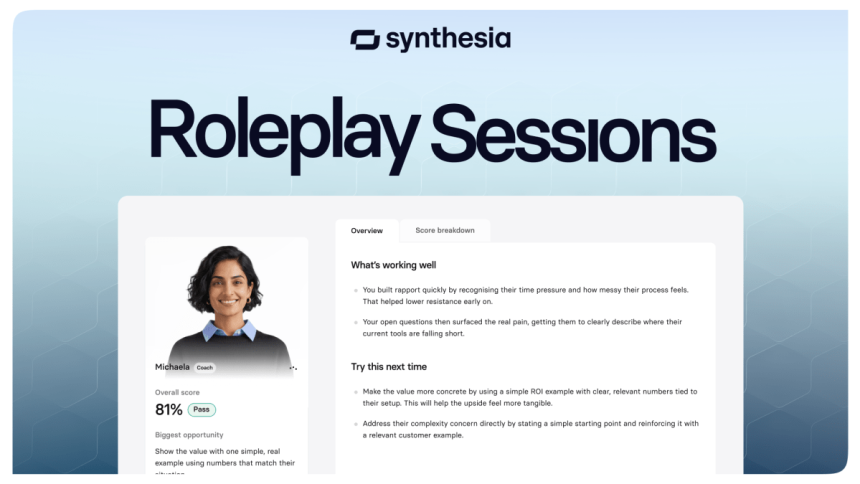
This week, the UK-based firm unveiled Roleplay Sessions, a sophisticated interactive training tool designed to move beyond passive consumption. This platform allows staff members to engage in high-pressure scenarios-such as navigating difficult customer grievances, conducting sensitive performance evaluations, or delivering high-stakes sales presentations-with an AI-driven avatar. Unlike static video content, these avatars are programmed to respond dynamically, challenge the user’s approach, and provide an objective assessment based on a predefined performance rubric.
The Evolution of the “Sessions” Ecosystem
Roleplay represents the inaugural feature of a more expansive “Sessions” architecture. According to internal insights, Synthesia intends to scale this platform to encompass a wider array of professional development use cases, including automated candidate screening and simulated job interviews. This transition marks a significant evolution for the company, moving from a content-generation tool to a comprehensive behavioral coaching engine.
Why Enterprises Are Demanding Measurable Outcomes
This product launch arrives at a critical juncture where corporate leaders are increasingly scrutinizing the ROI of their AI investments. Synthesia’s pivot is rooted in a growing body of learning science research, which suggests that traditional corporate training-even high-quality video modules-often fails to bridge the gap between information delivery and actual behavioral change. While video is undeniably more engaging than static text or dense policy manuals, it remains a one-way street.
“Video performs way better than text or sending out a document,” noted Victor Riparbelli, CEO and co-founder of Synthesia. However, the company acknowledges that true mastery requires active participation. By integrating real-time feedback loops, Synthesia is attempting to solve the “application gap,” ensuring that employees don’t just watch a tutorial, but actually practice the skills required to succeed in their roles.
As organizations shift their focus from “AI-generated content” to “AI-driven performance,” tools that simulate real-world friction are becoming essential. By forcing users to think on their feet, Synthesia is betting that the future of corporate training is not just about watching, but about doing.