




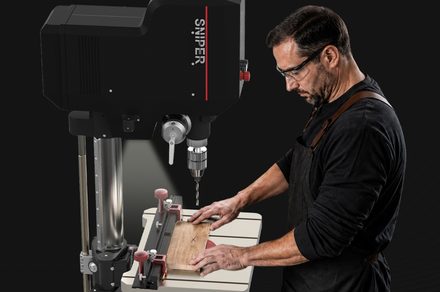
Image Credit: Harvey Industries Image used with permission by copyright holder
### The Evolution of the Workshop Staple: Why the Drill Press is Finally Catching Up
For nearly a hundred years, the drill press stood as a monument to stagnation in the modern workshop. While other machinery underwent radical transformations-CNC routers embraced digital precision, laser cutters integrated sophisticated software, and table saws adopted life-saving blade-detection sensors-the drill press remained largely frozen in time. Aside from minor cosmetic tweaks, the fundamental design of a cast-iron column topped with a chuck had barely evolved since the mid-1920s.
However, the industry is currently witnessing a rapid departure from this traditional stagnation. The long-overdue modernization of the drill press is finally gaining momentum, fundamentally altering how woodworkers approach their craft.
### Beyond Incremental Upgrades: The Digital Shift
For a long time, “innovation” in the power-tool sector was limited to incremental improvements. Manufacturers focused on motor efficiency and basic interface enhancements. We saw the gradual introduction of variable-speed drives, digital depth readouts, and programmable memory settings. While these features undoubtedly improved consistency and repeatability for production runs, they failed to address the most tedious aspect of the drilling process: the human element of alignment.
### Solving the “Alignment Tax”
The true hidden cost of drilling has always been the time spent on manual positioning. The standard workflow-marking the workpiece, lowering the quill, squinting to align the bit, readjusting, and verifying the center point-is a repetitive cycle that drains productivity. When tasked with a project like a 30-hole shelf-pin layout, this manual “hunt and peck” method can easily consume an entire afternoon.
Modern advancements are now targeting this specific bottleneck. By integrating smarter guidance systems and automated positioning, the latest generation of drill presses is removing the guesswork that has plagued woodworkers for decades. As these technologies become more accessible, the gap between manual labor and automated precision continues to shrink, signaling that the era of the “dumb” drill press is officially coming to an end.