





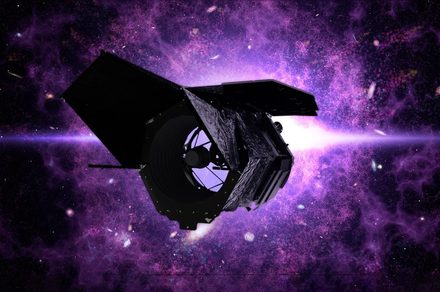
# A Dual-Purpose Sentinel: How the Roman Space Telescope Will Safeguard Earth
While the primary objective of the Nancy Grace Roman Space Telescope is to decode the enigmatic nature of dark energy and dark matter, its sophisticated engineering offers a significant secondary benefit: planetary defense. Scheduled for a May 2027 departure from the Kennedy Space Center, this observatory is poised to become an unexpected guardian of our planet.
### Beyond Dark Energy: A New Role in Planetary Defense
The mission was originally conceived to map the invisible architecture of the cosmos. By investigating how dark energy accelerates the expansion of the universe, scientists hope to understand the ultimate fate of galaxies. However, recent analysis suggests that the telescope’s hardware is perfectly calibrated to identify Near-Earth Objects (NEOs) that could pose a threat to our world.
According to reports from the MIT Technology Review, the Roman Telescope’s ability to scan vast swaths of the sky makes it an ideal candidate for asteroid detection. While current planetary defense systems often rely on ground-based surveys, the Roman Telescope will provide a high-resolution, space-based perspective that is currently unmatched in its efficiency.
### Unrivaled Imaging Power
The secret to the telescope’s versatility lies in its massive 300-megapixel infrared camera. To put its capabilities into perspective, the Roman Telescope can capture a field of view approximately 100 times greater than the Hubble Space Telescope.
Think of it this way: if Hubble is like looking at the night sky through a narrow straw, the Roman Telescope is like viewing the entire horizon at once. This wide-angle capability is essential for its primary mission of unlocking the mysteries of exoplanets and cosmic structures, but it also allows the observatory to monitor large regions of space for moving objects that might otherwise go unnoticed.
### Why This Matters for Earth
As of 2024, NASA’s Planetary Defense Coordination Office has tracked over 35,000 near-Earth asteroids. Despite these efforts, many smaller, “city-killer” sized asteroids remain undetected until they are relatively close to Earth. By utilizing the Roman Telescope’s infrared sensitivity, astronomers can detect the heat signatures of these dark, rocky bodies against the cold backdrop of space. This provides a critical early-warning system, potentially offering years of lead time to deflect a hazardous object-a luxury we do not currently have with many smaller NEOs.
By repurposing this cutting-edge technology, NASA is effectively turning a tool designed to look back at the dawn of time into a shield for our future.