





The Paradox of Bitcoin’s Stability: Why Extreme Volatility Still Persists
While the broader narrative surrounding Bitcoin suggests a maturing asset class with dampened price fluctuations, a closer look at 2026 market data reveals a counterintuitive reality. Despite a significant decline in annualized volatility-dropping from a historical 84% to a more tempered 46%-the frequency of “black swan” trading events has actually intensified.
The 2026 Volatility Anomaly
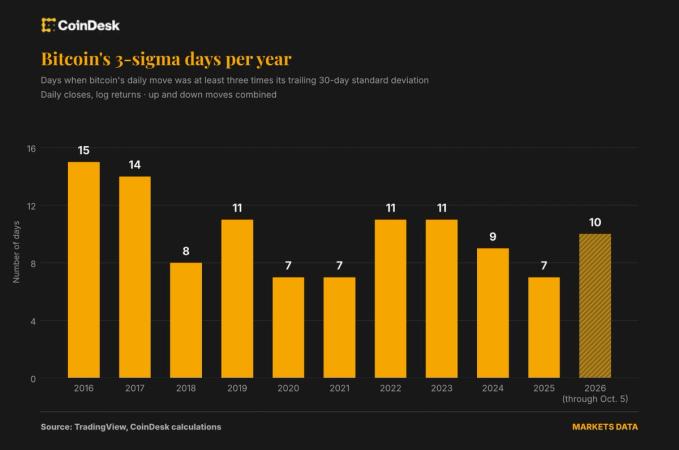
Data analysis indicates that Bitcoin has logged 10 distinct “three-sigma” trading days throughout 2026. To put this into perspective, this figure surpasses the eight extreme-move days recorded during the turbulent 2018 bear market.
This creates a unique paradox: the market appears calmer on the surface, yet it remains highly susceptible to sudden, violent price dislocations. For institutional investors and retail traders alike, this discrepancy highlights a growing disconnect between traditional risk assessment tools and the actual behavior of the digital asset market.
Why Standard Risk Models Are Failing
The reliance on Value-at-Risk (VaR) models-which typically anchor their projections on recent historical volatility-is becoming increasingly problematic. Because these models prioritize recent, lower-volatility data, they often fail to account for the “fat tails” or extreme outliers that characterize Bitcoin’s price action.
By underestimating these tail risks, investors may be inadvertently over-allocating capital to Bitcoin, assuming a level of stability that the market’s underlying structure does not yet support. Just as a calm sea can hide a sudden riptide, Bitcoin’s lower average volatility can mask the potential for rapid, high-magnitude shifts.
Drivers of Sudden Market Swings
Several factors contribute to these unexpected price spikes and crashes, even in a more liquid market:
* Macroeconomic Sensitivity: Bitcoin remains highly reactive to global liquidity shifts and central bank policy changes, which can trigger sudden, market-wide re-pricings.
* Derivatives Overcrowding: The proliferation of leveraged trading means that when a specific price threshold is breached, a cascade of liquidations can occur, artificially inflating the size of a move.
* Institutional Absorption: While the market is deeper and more institutionalized than in 2018, the sheer volume of capital moving in and out of the ecosystem can create temporary liquidity gaps, exacerbating price swings.
Navigating the New Crypto Landscape
For those tracking BTC$82,680.67, the lesson is clear: average volatility is no longer a reliable proxy for total risk. As the market continues to evolve, risk management strategies must move beyond simple standard deviation metrics to incorporate stress testing and scenario analysis that accounts for these frequent, extreme events.
While the market has undoubtedly matured, the “calm” of 2026 is deceptive. Investors who ignore the frequency of these three-sigma days do so at their own peril.







![[Event Review] Washington, D.C. Delivers on a Major Music Weekend](https://www.mixtv1.com/wp-content/uploads/2026/10/39901-attachment.jpg)