




Beyond Invisibility: How the “Phantom Twist” Drone Exploits Human Perception
For years, the aerospace industry has been obsessed with the “holy grail” of stealth: making drones physically vanish. Traditional attempts have relied on expensive, high-tech solutions like light-bending metamaterials, specialized radar-absorbent coatings, or complex optical cloaking arrays. However, a team of innovators at Northwestern University has pivoted away from these costly hardware solutions, opting instead to hack the most sophisticated sensor in the field: the human eye.
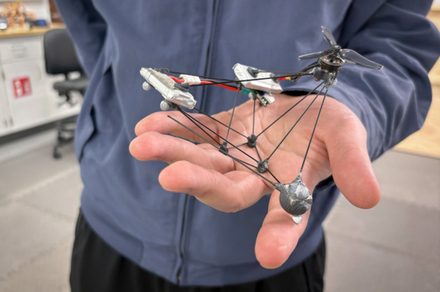
The result of this research is the “Phantom Twist,” a prototype that achieves a form of visual stealth not by hiding, but by moving in a way that the brain simply cannot process.
The Science of the Blur
Unveiled at the 2026 Robotics: Science and Systems conference in Sydney, the Phantom Twist challenges the assumption that stealth requires advanced materials. Instead, it leverages a phenomenon known as persistence of vision.
Think of a standard ceiling fan. When it is stationary, you can clearly distinguish the individual blades. However, once it reaches a high enough RPM, those blades seem to dissolve into a ghostly, semi-transparent disc. The Northwestern team applied this exact principle to drone flight. While a standard quadcopter keeps its chassis rigid while only the rotors spin, the Phantom Twist is engineered to rotate its entire frame at high velocities.
Redefining Stealth Through Motion
By spinning the entire body of the aircraft, the drone effectively “smears” its own image across the observer’s field of vision. To a human onlooker, the drone ceases to look like a mechanical object and instead appears as a faint, ethereal shimmer.
This approach offers several distinct advantages over traditional stealth technology:
* Cost-Efficiency: It eliminates the need for expensive, fragile cloaking materials.
* Weight Reduction: By removing the need for heavy optical systems, the drone maintains a better power-to-weight ratio.
* Simplicity: It relies on mechanical motion rather than complex, power-hungry electronics.
Why This Matters for Future Robotics
Current statistics in the drone industry suggest that as airspace becomes more crowded, the demand for “low-profile” aerial vehicles will skyrocket-not just for military applications, but for wildlife monitoring, urban surveillance, and environmental research where minimizing disturbance is key.
By exploiting the biological limitations of human sight, the Phantom Twist proves that you don’t always need to be invisible to be unseen. Sometimes, you just need to move faster than the eye can track.