




Beyond Fitness Tracking: The Reality of AI-Driven Health Monitoring in Wearables
Modern wearable technology has evolved significantly, transcending the basic pedometer functions that defined the early days of the industry. Today’s devices-ranging from sleek smartwatches to specialized rings-act as sophisticated diagnostic hubs, tracking metrics like blood oxygen saturation, heart rate variability (HRV), skin temperature, and respiratory patterns. While manufacturers often market these gadgets as revolutionary medical tools capable of identifying conditions like sleep apnea, it is essential to distinguish between consumer-grade wellness tracking and clinical-grade diagnostics.
The Gap Between Marketing Hype and Clinical Utility
When a tech giant secures FDA clearance for a new health-tracking feature, the accompanying marketing blitz often suggests a level of medical precision that may not exist in practice. We frequently see high-profile product launches punctuated by anecdotal success stories-tales of a watch detecting an undiagnosed heart condition or alerting a user to a fall. While these instances are undeniably impactful, they can create a “Tricorder effect,” where consumers begin to view their wrist-worn devices as infallible medical instruments.
The reality is more nuanced. While these devices are becoming increasingly adept at identifying physiological trends, they are not replacements for professional medical consultations. The challenge lies in the interpretation of data; a smartwatch might flag an anomaly in your resting heart rate, but it cannot provide the context of a clinical examination.
How AI Transforms Raw Data into Health Insights
The true power of current wearables lies in the integration of Artificial Intelligence. By processing vast amounts of longitudinal data, AI algorithms can establish a “baseline” for an individual user. When a user’s metrics deviate from this established norm-such as a sudden spike in skin temperature or a drop in HRV-the device can signal that the body is under stress, potentially indicating the onset of an infection or illness before the user feels symptomatic.
Recent studies have highlighted the potential of this technology. For example, research conducted during the COVID-19 pandemic demonstrated that wearables could detect physiological changes associated with viral infections days before patients reported symptoms. By analyzing subtle shifts in respiratory rate and activity levels, these AI models act as an early warning system, encouraging users to rest or seek testing sooner than they otherwise might.
Navigating the Limitations of Wearable Diagnostics
Despite the impressive capabilities of AI, there are inherent limitations to consider:
- Data Noise: External factors like alcohol consumption, intense exercise, or even stress can skew data, leading to “false alarms” that may cause unnecessary anxiety.
- Clinical Validation: Not all health features undergo the same level of rigorous, peer-reviewed clinical testing. Consumers should prioritize devices that have clear regulatory backing for specific health claims.
- The “Worried Well” Phenomenon: Constant monitoring can lead to health anxiety, where users become hyper-focused on minor fluctuations that have no clinical significance.
The Future of Proactive Healthcare
As we look ahead, the integration of wearables into the broader healthcare ecosystem seems inevitable. We are moving toward a model of “preventative monitoring,” where your primary care physician might eventually use your wearable data to track the efficacy of a treatment plan or monitor chronic conditions remotely.
However, for now, it is best to view your smartwatch as a supportive tool rather than a diagnostic authority. It is an excellent instrument for maintaining awareness of your general well-being, but it should never replace the expertise of a healthcare professional. When your device alerts you to a potential issue, treat it as a prompt for a conversation with your doctor, not as a definitive medical diagnosis.
Beyond the Hype: Evaluating the Real-World Utility of Wearable Health Tech
The integration of wearable technology into our daily lives has moved from a niche hobbyist trend to a central pillar of modern wellness discourse. Even high-profile figures like Robert F. Kennedy Jr. have championed these devices, positioning them as essential tools for personal health management. But as the market becomes saturated with sensors promising to track everything from blood oxygen to stress levels, it is time to separate genuine medical utility from clever marketing.
Are these gadgets truly revolutionizing healthcare, or are we simply paying for expensive digital placebos? The reality is nuanced: while wearables are remarkably adept at identifying deviations from your personal baseline, they are not yet sophisticated enough to serve as primary diagnostic tools. Understanding the distinction between “data collection” and “clinical diagnosis” is vital for any user.

The Strengths: Where Wearables Excel
The primary value of a smartwatch or fitness tracker lies in its ability to monitor longitudinal data. By establishing a baseline of your typical physiological patterns, these devices become highly effective at flagging anomalies that might otherwise go unnoticed. When your body deviates from its norm, it serves as a digital “check engine” light, signaling that a conversation with a healthcare professional may be in order.
The most successful application of this technology to date is the detection of atrial fibrillation (AFib). Because AFib presents a distinct electrical signature in the heart, modern sensors can identify these irregularities with impressive accuracy. Research, including data from large-scale Apple Watch studies, has shown that irregular pulse notifications correlate with confirmed AFib diagnoses approximately 84% of the time. This level of precision has earned the respect of the medical community, as it provides actionable data that can prevent life-altering events like strokes.
Beyond cardiac monitoring, the consensus among medical experts is that the most reliable metrics remain the simplest ones. Tracking daily step counts and general sleep duration-rather than granular, often speculative “sleep stage” breakdowns-provides a consistent, verifiable picture of your physical activity and recovery. Currently, these foundational metrics are the gold standard for consumer-grade health tracking.
Navigating the Boundaries of Digital Health
While the potential for AI-driven health monitoring is vast, users must remain cautious about the limitations of current hardware. A common misconception is that a smartwatch can “diagnose” an illness. In truth, most devices are designed to track trends, not to interpret complex clinical symptoms. Relying on a wearable to identify a specific disease can lead to unnecessary anxiety or, conversely, a false sense of security.
Recent industry reports highlight that while AI algorithms are becoming more adept at spotting early signs of infection-such as subtle shifts in resting heart rate or skin temperature-these are non-specific indicators. A spike in your heart rate could be a sign of an impending flu, or it could simply be the result of a stressful day or a late-night caffeine intake.
As we look toward the future, the goal of wearable tech should be to bridge the gap between the consumer and the clinic. Until then, treat your device as a helpful companion for lifestyle tracking rather than a substitute for a physical examination. If your wearable alerts you to a persistent anomaly, use that data as a starting point for a professional consultation, not as a definitive medical conclusion.
The Clinical Reality of Wearable Health Data
While modern smartwatches and fitness trackers have become ubiquitous, there is a significant gap between the data they collect and the information a physician can actually use. Despite the marketing hype surrounding advanced health sensors, the medical community remains cautious about integrating these consumer-grade metrics into formal diagnostic workflows.
Why Consumer Metrics Fall Short for Medical Diagnosis
The primary issue lies in the lack of clinical-grade precision. Features such as blood pressure monitoring, calorie expenditure calculations, and granular sleep-stage analysis are often viewed by healthcare professionals as unreliable for making definitive medical decisions.
Furthermore, many of the “wellness scores” popularized by brands like Oura or Whoop are derived from proprietary, “black-box” algorithms. Because these formulas are not transparent or standardized, clinicians cannot validate the data against established medical benchmarks. Even metrics that are technically more accurate, such as VO2 max or heart rate variability (HRV), serve better as general fitness indicators rather than diagnostic tools.
The Challenge of Context and False Positives
A major hurdle in wearable technology is the high rate of false positives. For instance, a sudden elevation in resting heart rate is often flagged by an app as a potential health concern. While this could indicate an underlying infection, it is just as likely to be a byproduct of poor sleep hygiene, high caffeine intake, or a late-night meal.
Because these devices excel at identifying anomalies but struggle to provide a root-cause analysis, they often create more anxiety than clarity. Consequently, medical practitioners prioritize long-term longitudinal trends over isolated, daily data points, as a single reading is rarely representative of a patient’s overall health status.
The Power of Multi-Metric Synthesis
While individual data points may be noisy, the real potential of wearable technology lies in the synthesis of multiple physiological signals. When viewed in isolation, a slight fluctuation in skin temperature or respiratory rate is statistically insignificant. However, when these metrics are aggregated and compared against an individual’s established baseline, they form a powerful diagnostic pattern.
Recent advancements in data science have highlighted how wearables can act as early-warning systems for systemic health issues. Rather than identifying a specific pathogen, these devices detect the body’s physiological reaction to stress or illness.
Predictive Health and Pandemic Mitigation
The utility of this multi-metric approach is particularly evident in the detection of respiratory illnesses. A collaborative study conducted by researchers at Texas A&M and Stanford University demonstrated that smartwatches could identify physiological markers of COVID-19 and influenza within hours of initial exposure-often well before the user experiences any physical symptoms.
The implications for public health are profound. By leveraging these early warnings, individuals can proactively isolate, seek testing, and begin treatment sooner. Researchers estimate that if such wearable-driven interventions were widely adopted, they could potentially reduce the transmission rate of future pandemics by as much as 50 percent. This shift from reactive care to predictive monitoring represents the most promising frontier for wearable technology in the medical field.
The Evolution of Wearable Health: Beyond the Wrist-Worn Tricorder
While the intersection of seasonal illnesses, global health crises, and wearable technology is not a new phenomenon, we are currently witnessing a paradigm shift. The rapid maturation of artificial intelligence and advanced sensor arrays is transforming passive tracking devices into proactive health companions. Industry leaders such as Google, Oura, and Whoop are leading this charge, integrating sophisticated AI-driven coaching modules designed to translate raw biometric data into meaningful, personalized insights.
The Rise of Intelligent Health Monitoring
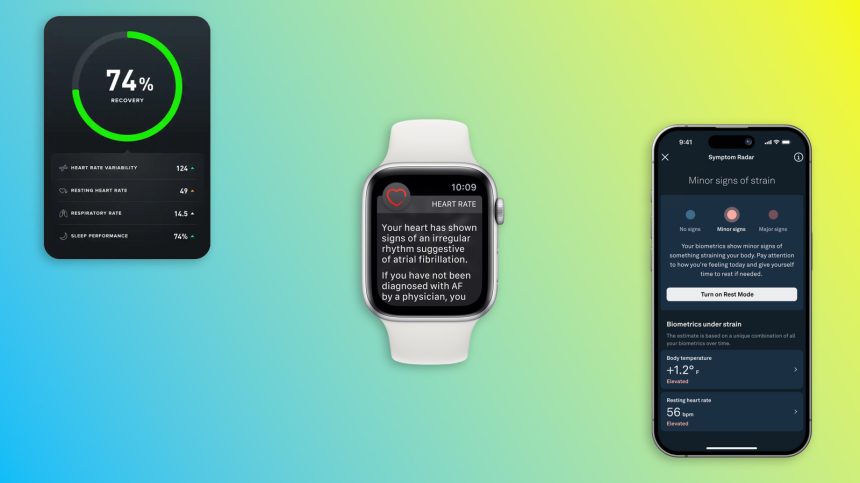
Modern health tracking has moved well beyond simple step counting. We are seeing the emergence of “invisible” AI-features that operate in the background to synthesize complex data streams. For instance, tools like Oura’s Symptom Radar and Apple’s Vitals function by continuously monitoring your physiological baseline and flagging deviations that might indicate an underlying issue.
The integration of large language models, such as Google’s Gemini within the Fitbit Health Coach, represents the next frontier. These systems aim to bridge the gap between data collection and actionable advice. However, a significant hurdle remains: much of this analysis occurs within “black box” algorithms. Because these proprietary recovery scores and AI insights are often opaque, they currently lack the clinical validation required for physicians to incorporate them into formal medical treatment plans.
The Double-Edged Sword of AI Diagnostics
The integration of AI into personal health creates a complex landscape of potential benefits and risks. On the positive side, these systems act as an early warning signal, potentially prompting users to seek medical attention before a condition escalates. According to recent industry reports, early detection of physiological anomalies-such as elevated resting heart rate or respiratory changes-can lead to significantly better outcomes for viral infections and chronic condition management.
Conversely, there is a growing concern regarding the “automation bias” of health data. When a user receives a notification from a sophisticated algorithm, there is a psychological temptation to treat that output as a definitive medical diagnosis. Relying on a chatbot or a wrist-worn sensor as a substitute for professional medical consultation is a dangerous trend. While these devices are becoming more accurate, they are not diagnostic tools in the clinical sense.
Redefining the Future of Wearable Tech
The dream of a “medical tricorder”-a device that provides instant, hospital-grade diagnoses from your wrist-remains largely science fiction. The reality of the future is far more nuanced. Instead of replacing the doctor, the next generation of wearables will function as a silent, persistent observer.
By identifying subtle patterns that a human might miss, these devices serve as a bridge to better healthcare. They provide the context necessary for more productive conversations with your primary care physician. Ultimately, the value of your smartwatch or smart ring lies not in its ability to tell you exactly what is wrong, but in its capacity to alert you when it is time to seek the expertise of a qualified medical professional. Your data is a conversation starter, not a final verdict.