


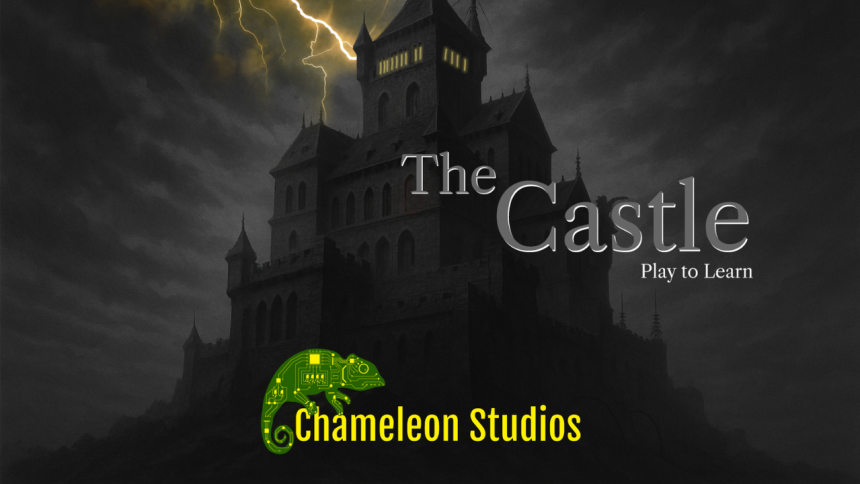
Gamifying Physics: How “The Castle” Uses VR to Teach Electrical Engineering
Virtual reality is moving beyond simple entertainment, carving out a vital niche in the education sector. A standout example is The Castle, an immersive, dungeon-crawling experience developed by Chameleon Studios. Designed to demystify complex electrical engineering concepts, the game transforms dry textbook theory into a high-stakes, escape-room-style adventure.
A Narrative-Driven Approach to STEM
The premise of The Castle is rooted in literary inspiration. Players step into the shoes of an apprentice working for Nigel Kupferman, a fictional baron obsessed with the lore of Mary Shelley’s Frankenstein. Having acquired a historic fortress to replicate the legendary experiment, Kupferman’s ambition leads to a catastrophic power failure. As Cecil Colvin, Managing Director at Chameleon Studios, points out, the sheer voltage required to animate a creature would realistically fry any electrical grid-and that is exactly where the player’s journey begins.
Rather than relying on static lectures, the game uses Kupferman as a narrative guide. As you navigate the dungeon, he provides real-time instructions, blending storytelling with the underlying physics of electrical repair. This method mirrors the “active learning” pedagogical model, which studies show can improve student retention rates by up to 50% compared to passive listening.
Hands-On Technical Training
The gameplay loop focuses on practical application. Within the dark, atmospheric walls of the dungeon, players must perform essential electrical tasks, such as:
- Calibrating amperage levels to match circuit requirements.
- Diagnosing and replacing blown fuses.
- Configuring battery arrays to restore power.
- Utilizing digital multimeters to take precise voltage readings.
The design philosophy prioritizes accessibility. By stripping away complex inventory management and convoluted control schemes, Chameleon Studios ensures that the focus remains entirely on the electrical concepts. Interactions are intuitive, allowing users to grasp the “why” behind the “how” without getting bogged down by clunky mechanics.
Scaling Complexity and Future Potential
The current demo, titled “The Basement,” serves as the introductory chapter of a four-part series. As players advance through the remaining levels, the difficulty is set to scale, introducing more intricate circuitry and advanced physics problems. There is also a layer of narrative intrigue; Colvin hints that Kupferman’s motives may not be entirely altruistic, adding a layer of mystery that keeps the player engaged throughout the technical lessons.
For kinesthetic learners-those who learn best through physical interaction-this VR application is a game-changer. It bridges the gap between abstract formulas and real-world application. While the current version provides helpful guidance, the potential for future iterations is immense. By eventually removing the


![[Listen]¥ØU$UK€ ¥UK1MAT$U Honors The Prodigy With NTS Radio Mix](https://www.mixtv1.com/wp-content/uploads/2026/08/22920-attachment.jpg)