




Defeating Surveillance: How Adversarial Patterns Are Blinding AI Cameras
Key Takeaways
* The noRecognition Initiative: Security researcher Bill Swearingen has developed specialized visual patterns designed to render objects, vehicles, and individuals invisible to automated computer vision systems.
* Proven Efficacy: These adversarial designs successfully bypassed 11 distinct open-source detection models, including the underlying technology utilized by Clearview AI, Axon body-worn cameras, and Flock Safety’s widespread license plate recognition systems.
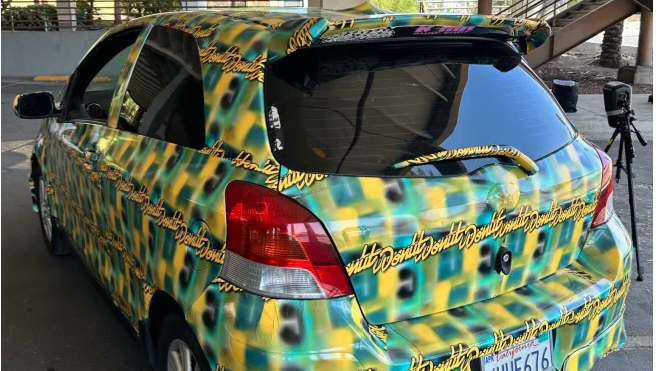
* Real-World Validation: The technology faced its first live-fire test at the Def Con conference in Las Vegas, where a patterned 2009 Toyota Yaris successfully evaded detection by a deployed Flock camera.
The Science of Digital Invisibility
For the past year, Bill Swearingen, a co-founder of the Kansas City-based security collective SecKC, has been engaged in an exhaustive research project. By running over 31 million iterative simulations, Swearingen has successfully engineered a method to generate custom patterns that effectively “blind” AI-driven surveillance. These patterns act as a digital camouflage, confusing the neural networks that power modern automated monitoring tools, such as the controversial Flock Safety systems currently being deployed in municipalities across the United States.
Putting Theory to the Test at Def Con
While the efficacy of these patterns was previously confined to laboratory simulations, the theory was put to the ultimate test during the Def Con security conference. In a collaborative effort with the automotive-focused YouTube channel Donut Media, Swearingen applied his latest adversarial design to a 2009 Toyota Yaris. As the vehicle drove past a live Flock camera, the software failed to register the car, demonstrating a significant vulnerability in current automated surveillance infrastructure.
The Growing Threat of AI Surveillance
The implications of this research are profound. As cities increasingly rely on automated license plate readers (ALPRs) and facial recognition, the ability to opt out of constant tracking has become a central concern for privacy advocates. Recent data suggests that the global market for video surveillance is expected to reach over $100 billion by 2030, driven largely by the integration of AI-powered analytics. Swearingen’s work highlights a critical “cat-and-mouse” game: as surveillance algorithms become more sophisticated at identifying patterns, researchers are finding equally sophisticated ways to exploit the mathematical blind spots inherent in machine learning.
Myriad: How many days will Claude go down in August? Click to make your prediction. » More Info >>>