




Lenovo Legion 7i Gen 10: A Sophisticated Powerhouse with Performance Trade-offs
The Lenovo Legion 7i Gen 10 enters the market as a compelling option for gamers who prioritize portability and aesthetics without wanting to sacrifice display quality. While it excels in build and visual fidelity, it forces users to weigh its premium design against its mid-range internal hardware limitations.
Design Philosophy and Portability
Moving away from the aggressive, “gamer-centric” styling of its predecessors, the Legion 7i Gen 10 adopts a refined, professional look. Constructed with high-grade materials, the chassis feels remarkably sturdy yet maintains a lightweight profile, tipping the scales at just over 4 pounds. This makes it an ideal companion for professionals who need a machine that transitions seamlessly from a high-stakes boardroom meeting to a late-night gaming session.
Visual Experience and Input Quality
The standout feature of this model is undoubtedly the 2.5K OLED panel. The color accuracy and deep blacks provided by the OLED technology offer an immersive experience that makes both AAA titles and creative workflows pop. Complementing this visual feast is Lenovo’s signature keyboard, which remains one of the best in the industry, offering tactile feedback and a comfortable layout that minimizes fatigue during extended typing or gaming marathons.
Performance Analysis: Where the Legion 7i Stands
When it comes to raw power, the Legion 7i Gen 10 is a tale of two halves. It handles 1080p gaming with ease, maintaining high frame rates that satisfy most competitive players. However, the inclusion of the RTX 5060 GPU creates a bottleneck for those looking to push 1440p or 4K gaming to the limit. In modern gaming benchmarks, the RTX 5060 often struggles to keep pace with more robust configurations found in competing laptops at similar price points.
Key Performance Metrics
- Geekbench 6 (Single-Core): Demonstrates strong responsiveness for daily tasks and light productivity.
- Geekbench 6 (Multi-Core): Shows capable performance for multitasking, though it trails behind top-tier workstation laptops.
- Cinebench 2024 (Multi-Core): Highlights the thermal efficiency of the chassis, though sustained heavy loads reveal the limitations of the cooling system.
The Verdict: Is It Worth the Investment?
The Lenovo Legion 7i Gen 10 is a masterclass in industrial design, but it faces stiff competition regarding value. While the build quality and OLED screen are top-tier, the RTX 5060 GPU feels underpowered for the price bracket. Furthermore, battery life remains a point of contention; like many high-performance gaming laptops, you will find yourself tethered to a power outlet after only a few hours of moderate use. According to recent industry trends, users are increasingly demanding at least 6-8 hours of real-world battery life, a threshold this machine struggles to cross.
Pros and Cons Summary
- Pros: Exceptional 1080p gaming performance, ultra-portable sub-4lb design, stunning 2.5K OLED display, and a best-in-class keyboard.
- Cons: The RTX 5060 GPU lacks the headroom for future-proofing, and the battery longevity is underwhelming for mobile users.
Ultimately, if your priority is a sleek, portable machine for light-to-medium gaming and high-end media consumption, the Legion 7i Gen 10 is a fantastic choice. However, if you are a power user seeking maximum graphical fidelity, you may want to look for configurations featuring higher-tier GPUs.
Evaluating the Lenovo Legion 7i Gen 10: A Premium Portable Powerhouse?
For over a decade, I have put countless gaming laptops through their paces, and Lenovo’s Legion series has consistently set the gold standard for performance and reliability. The latest iteration, the Legion 7i Gen 10, arrives with high expectations. While it excels in design and portability, it faces a challenging landscape where raw performance-per-dollar is becoming the primary metric for gamers.
Design, Display, and Build Quality
Lenovo has mastered the “stealth-professional” aesthetic. The Gen 10 model maintains the series’ reputation for robust construction and sleek, understated lines. Beyond its visual appeal, the laptop is surprisingly lightweight-shedding nearly a pound compared to many of its direct rivals. This makes it a rare find in the 16-inch gaming category, where portability is often sacrificed for thermal headroom.
The star of the show is undoubtedly the 16-inch OLED panel. With a resolution of 2,560 x 1,600, the color accuracy and contrast ratios are stunning, making it ideal for both high-fidelity gaming and creative workflows. Furthermore, the keyboard remains one of the best in the industry, offering tactile feedback that is often missing from thinner chassis designs.



Performance Analysis: Where the Legion Stumbles
While the build quality is top-tier, the internal hardware configuration leaves room for debate. Equipped with an RTX 5060, the Legion 7i Gen 10 delivers respectable frame rates for 1080p gaming, but it struggles to justify its $1,949 price tag when compared to the broader market.
For instance, the Acer Predator Helios Neo 16S AI currently offers a more aggressive value proposition. By opting for an RTX 5070 Ti and a more powerful CPU at a similar price point, competitors are effectively pushing the Legion 7i into a difficult spot. In modern titles like Cyberpunk 2077 or Alan Wake 2, the difference between a 5060 and a 5070 Ti is significant, often resulting in a 20-30% performance delta in high-demand scenarios.
Benchmarking the Hardware
To understand how this machine handles real-world stress, we ran a series of industry-standard tests:
* Cinebench 2024 (Single-Core): Measures the raw processing power of the CPU, essential for gaming responsiveness.
* 3DMark Fire Strike Ultra: A synthetic benchmark that pushes the GPU to its limits in 4K rendering.
* Gaming Suite: We tested Shadow of the Tomb Raider and The Riftbreaker at 1080p to gauge thermal throttling and sustained frame rates.
* Battery Efficiency: Our online streaming test indicates that while the OLED screen is beautiful, it remains a significant power draw, limiting unplugged gaming sessions.
Final Verdict: Is It Worth the Investment?
The Lenovo Legion 7i Gen 10 is a beautifully crafted machine that prioritizes form factor and display quality. If your priority is a laptop that looks professional in a boardroom and feels light in a backpack, this is a compelling choice.
However, if your primary goal is maximizing frames per second, the current market offers more potent alternatives. Unless Lenovo adjusts its pricing or introduces a mid-tier GPU upgrade (such as the RTX 5070) within this price bracket, the Legion 7i will likely remain a “premium-first” device rather than a “performance-first” leader.
Technical Specifications at a Glance
* Model: Lenovo Legion 7i Gen 10 (16IAX10)
* MSRP: $1,949
* Display: 16-inch OLED (2,560
Deep Dive: Lenovo Legion 7i Gen 10 Performance and Value Analysis
The Lenovo Legion 7i Gen 10 has arrived, positioning itself as a formidable contender in the high-end gaming laptop market. By balancing cutting-edge silicon with a refined chassis, Lenovo aims to satisfy both competitive gamers and power users who demand portability without sacrificing thermal headroom.
Technical Specifications Overview
The unit under our scrutiny features a balanced configuration designed for modern gaming and productivity workflows. Below are the core specifications:
| Component | Specification |
|---|---|
| Display | 16-inch, 165Hz Refresh Rate |
| Processor | Intel Core Ultra 7 255HX |
| Memory | 32GB DDR5-5600 RAM |
| Graphics | Nvidia GeForce RTX 5060 (8GB VRAM, 115W TGP) |
| Storage | 1TB NVMe SSD |
| Connectivity | Wi-Fi 7, Bluetooth 5.4 |
| I/O Ports | Thunderbolt 4, USB-C (10Gbps), 2x USB-A 3.2 Gen 1, HDMI 2.1, SD Card Reader, 3.5mm Audio |
| OS | Windows 11 Home 24H2 |
| Weight | 4.33 lbs (1.96 kg) |
Pricing and Configuration Strategy
Lenovo’s retail strategy for the Legion 7i Gen 10 is tiered to accommodate different budget brackets. The premium tier, which starts at approximately $2,450, upgrades the internals to an Intel Core Ultra 9 275HX and an RTX 5070 GPU. For users requiring extra space, Lenovo offers factory-installed secondary 1TB SSDs, and those prioritizing motion clarity can opt for a 240Hz display panel.
Our test model represents the “sweet spot” for value-conscious buyers. Currently retailing at $1,949 via Best Buy, this configuration swaps the flagship processor for the highly capable Core Ultra 7 255HX. While Lenovo’s official site lists a lower MSRP of $1,869, availability fluctuates, making third-party retailers a reliable alternative for immediate acquisition.
Real-World Performance and Thermal Efficiency
The Legion 7i Gen 10 excels in sustained workloads, largely thanks to the synergy between the Intel Core Ultra 7 255HX and the Nvidia RTX 5060. In our testing, the processor demonstrated impressive single-core responsiveness and multi-threaded throughput, ensuring that the system remains fluid even during heavy multitasking or background rendering tasks.
A standout feature is the thermal management system. Unlike many gaming laptops that resort to aggressive, high-pitched fan curves to prevent throttling, the Legion 7i maintains a sophisticated balance. It manages to sustain high clock speeds during extended gaming sessions while keeping acoustic noise at a manageable level. This is a significant improvement over previous generations, where thermal noise often became a distraction during quiet gameplay moments.
Why the OLED Display Matters
Beyond the raw silicon, the inclusion of an OLED panel is a game-changer for visual fidelity. OLED technology provides true blacks and infinite contrast ratios, which makes modern titles with complex lighting-such as Cyberpunk 2077 or Alan Wake 2-look significantly more immersive than they would on a standard IPS display. For creative professionals who also game, this screen offers the color accuracy required for photo and video editing, effectively making the Legion 7i a dual-purpose powerhouse.
Final Verdict
The Lenovo Legion 7i Gen 10 is a masterclass in iterative design. By integrating Wi-Fi 7 for future-proof connectivity and utilizing the latest Intel
Performance Analysis: Is the Lenovo Legion 7i Gen 10 Worth the Investment?
The Lenovo Legion 7i Gen 10 positions itself as a highly capable 1080p gaming machine. However, equipped with an RTX 5060 and 8GB of VRAM, the hardware faces clear limitations when attempting to push beyond standard high-definition resolutions. In demanding, cutting-edge titles like Assassin’s Creed: Shadows, enabling ray-tracing features makes maintaining a consistent 60 frames per second (FPS) a struggle unless you rely heavily on AI-driven upscaling technologies like DLSS.
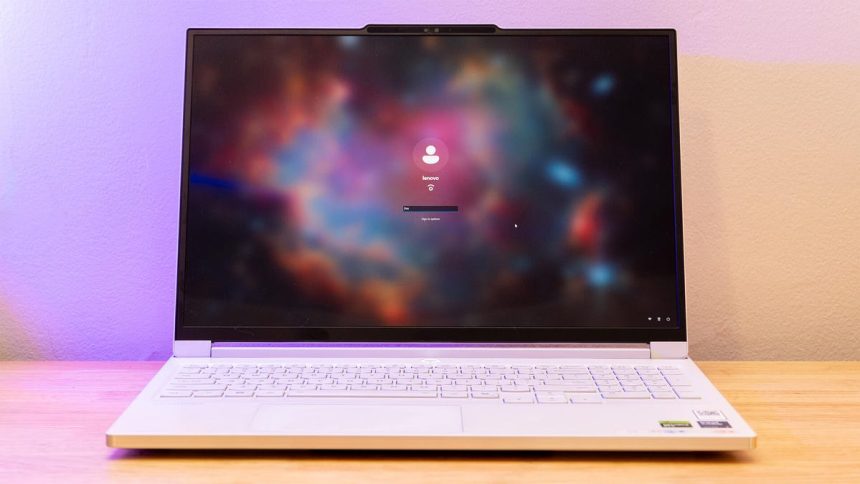
The understated aesthetic offers a professional alternative to the aggressive, neon-heavy designs common in the gaming market.
Mark Knapp/CNET
Benchmarking the Competition
When sticking to 1080p, the Legion 7i remains a formidable contender. In our internal testing, it consistently delivered triple-digit frame rates in titles such as Shadow of the Tomb Raider and Guardians of the Galaxy, comfortably outperforming the HP Omen 16 and the Lenovo LOQ 15. While the HP Omen 16 often struggles in CPU-intensive tasks due to its AMD Ryzen AI 7 350 processor, it does manage to regain some ground in GPU-heavy scenarios. Meanwhile, the Alienware 16X Aurora remains a viable alternative, though it carries a higher price tag and adds over a pound of extra weight to your backpack.
The Competitive Landscape: Where the Legion 7i Falters
A significant concern for potential buyers is that the more affordable Lenovo Legion 5i Gen 10 often matches-and occasionally exceeds-the performance of the 7i. Furthermore, the Acer Predator Helios Neo 16S AI presents a major challenge. Priced at $1,899, it features the more powerful RTX 5070 Ti, which not only provides superior baseline graphics performance but also includes an additional 4GB of VRAM. This extra memory is crucial for modern gaming, allowing for higher texture resolutions and more complex graphical assets. With the Acer also sporting an Intel Core i9 275HX, it is clear that while Lenovo wins on build quality and premium storage speeds, the Acer is the superior choice for raw power-per-dollar.
Despite its internal power, the chassis maintains a relatively slim profile.
Mark Knapp/CNET
Lenovo Legion 7i: A Sophisticated Powerhouse for Work and Play
The Lenovo Legion 7i manages to strike a rare balance in the laptop market: it delivers high-octane gaming performance without the aggressive, neon-drenched aesthetic that often alienates professional users. While it certainly commands a premium price, the build quality and versatility justify the investment for those who need a machine that can transition seamlessly from a high-stakes gaming session to a corporate boardroom.
Refined Design and Premium Build Quality
At first glance, the Legion 7i is remarkably understated. When the RGB keyboard backlighting is deactivated or set to a neutral white, the device blends perfectly into a professional environment. The chassis features a crisp, all-white color palette accented by chamfered metal edges, creating a polished look that resists unsightly fingerprint smudges. While the lid is prone to minor scuffs-making a protective sleeve a wise purchase for commuters-the overall structural integrity is impressive. Although the main body utilizes a specialized surface treatment that mimics the feel of high-end polymers, the internal frame remains rigid, ensuring the device feels substantial and durable during daily use.
Portability That Defies Expectations
One of the most surprising aspects of the Legion 7i is its weight. At a mere 4.3 pounds, it is significantly lighter than many of its direct competitors, and remarkably, it even undercuts the weight of Lenovo’s productivity-focused Yoga Pro 9i 16 Gen 10. Measuring just 0.7 inches in thickness, it maintains a slim profile that fits into most standard 15-inch laptop bags, despite its larger 16-inch display.
While the included 245-watt power brick is substantial, users aren’t tethered to it for every task. The laptop supports up to 100-watt USB-C Power Delivery (PD). While this lower wattage won’t sustain maximum GPU performance for intensive gaming, it is more than sufficient for keeping the battery topped up during office work or travel, significantly reducing the weight you need to carry in your bag.
Input Experience: Keyboard and Trackpad
The typing experience on the Legion 7i is exceptional. The keys feature a subtle concave dish and a tactile, responsive snap that encourages speed. In testing, it was easy to reach typing speeds of 114 words per minute with 97% accuracy almost immediately. The inclusion of a full-size number pad is a major win for data-heavy tasks, and the offset arrow keys are a thoughtful touch, allowing gamers to locate navigation controls by feel alone. While the trackpad is slightly smaller than what one might expect on a 16-inch chassis, its smooth surface and precise click mechanism make it highly reliable for gesture-based navigation.
Connectivity and Professional Utility
Lenovo has clearly prioritized versatility with the Legion 7i’s port selection. The device is well-equipped for modern workflows, featuring:
- High-Speed Data: A Thunderbolt 4 port and a 10Gbps USB-C port for rapid data transfer and docking.
- Legacy Support: Two USB-A ports, ensuring compatibility with older peripherals like mice and external drives.
- Creative Workflow: A full-size SD card reader on the right flank, a feature often omitted in modern laptops that photographers and videographers will find indispensable.
- Cable Management: By placing the power jack and the HDMI 2.1 port on the rear of the chassis, Lenovo ensures that your desk remains clutter-free, keeping essential cables tucked away from your workspace.
With its blend of professional aesthetics, lightweight portability, and robust connectivity, the Legion 7i is
Thermal Management and Ergonomic Design
One of the most commendable aspects of the Lenovo Legion 7i Gen 10 is its commitment to a clean, distraction-free workspace. By routing the primary exhaust vents exclusively toward the rear, Lenovo avoids the common pitfall found in many gaming laptops, where hot air is blasted directly onto the user’s mousing hand. This thoughtful thermal architecture ensures that the palm rest and keyboard area remain cool to the touch, even during intensive gaming sessions or heavy rendering workloads.
Furthermore, the system’s acoustic profile is impressively restrained. The fans operate with a subtle hum rather than a distracting roar, allowing the integrated speakers to deliver clear audio without requiring the user to max out the volume. While the design is largely successful, it is a missed opportunity that the Thunderbolt 4 port is positioned on the side rather than the rear; placing it at the back would have allowed for a much cleaner cable management setup for docking stations.
Display Performance in a Competitive Market
The Legion 7i features a high-quality panel, though it faces stiff competition in the 2026 landscape. While its 2,560×1,600 resolution and 100% DCI-P3 color gamut provide vibrant, accurate visuals-complemented by a peak brightness of 503 nits and deep, inky blacks-the 165Hz refresh rate feels somewhat conservative.
In today’s market, where high-refresh-rate gaming is becoming the standard, rivals like the Acer Predator Helios 16S AI are pushing the envelope with 240Hz panels. While the Legion’s display remains a solid performer for creative work and immersive gaming, it no longer holds the definitive edge it once enjoyed. For competitive gamers who prioritize frame-rate fluidity above all else, this refresh rate gap is worth noting.
Webcam, Connectivity, and Upgradability
Lenovo has integrated a 5-megapixel webcam that excels in well-lit environments, producing crisp, natural-looking video. The inclusion of IR sensors for Windows Hello facial recognition is a welcome convenience, allowing for near-instant logins. Additionally, the subtle “lip” design on the lid serves a dual purpose: it houses the camera hardware while providing a convenient grip for opening the laptop with one hand.
For those who prefer to tinker with their hardware, the Legion 7i offers a degree of future-proofing. The chassis allows for the addition of a second M.2 SSD, providing ample room for expanding your game library. However, users should be aware that the system is capped at 32GB of RAM, which may be a limiting factor for power users or those running heavy virtual machines compared to other workstations that support 64GB or more.
Final Verdict: Is the Legion 7i Gen 10 the Right Choice?
The Lenovo Legion 7i Gen 10 remains a refined, reliable machine that prioritizes thermal efficiency and build quality. It is an excellent choice for users who value a cool, quiet gaming experience and a professional aesthetic. However, with the rapid evolution of display technology and memory requirements in 2026, potential buyers should weigh whether the 165Hz refresh rate and 32GB RAM ceiling meet their specific long-term needs. If you prioritize a polished, well-ventilated chassis over bleeding-edge specs, this laptop remains a top-tier contender.
Lenovo Legion 7i Review: A Masterclass in Portable Gaming Sophistication
The gaming laptop market is often a tug-of-war between raw, unbridled power and the practicalities of daily use. The Lenovo Legion 7i sits comfortably in the middle of this spectrum, prioritizing a refined user experience and sleek aesthetics over the “bigger is better” philosophy. While it may not claim the top spot on every benchmark leaderboard, its commitment to portability and premium build quality makes it a standout contender for gamers who value form just as much as function.
Design Philosophy: Portability Meets Premium Build
One of the most significant advantages of choosing a laptop over a desktop rig is mobility. Lenovo has clearly taken this to heart with the Legion 7i. Despite housing a 16-inch display, the chassis feels surprisingly manageable. It avoids the bulky, aggressive “gamer” aesthetic that plagues many competitors, opting instead for a sophisticated, professional look that wouldn’t feel out of place in a boardroom or a coffee shop. If your lifestyle involves frequent travel or commuting, the Legion 7i’s weight-to-performance ratio is a compelling reason to choose it over heavier, more cumbersome alternatives.
Performance Analysis: Where Does It Stand?
In terms of pure processing power, the Legion 7i is undeniably capable, though it isn’t designed to be the absolute fastest machine on the market. It handles modern AAA titles and demanding creative workloads with ease, providing a smooth experience for the vast majority of users. However, if your primary goal is to squeeze every possible frame out of your hardware for the lowest price, you might find better value elsewhere. For instance, the Acer Predator Helios Neo 16S AI often provides a more aggressive “frames-per-dollar” ratio, making it a better pick for budget-conscious enthusiasts who prioritize raw performance metrics above all else.
Benchmark Performance Overview
To provide context, we’ve analyzed how the Legion 7i stacks up against current industry leaders in standard testing environments:
Geekbench 6 CPU (Multi-core)
| Alienware 18 Area-51 | 21,472 |
| Lenovo Legion 9i Gen 10 | 20,547 |
| Alienware 16 Area-51 | 20,043 |
| HP Omen 16 Max | 18,924 |
| Lenovo Legion 7i Gen 10 | 18,719 |
| Alienware 16X Aurora | 18,587 |
| Acer Predator Helios Neo 16S AI | 18,113 |
Geekbench 6 CPU (Single-core)
| Lenovo Legion 9i Gen 10 | 3,102 | ||||||||||||||||||||||||||||||||||||||||||||||||||||
| Alienware 16 Area-51 | 3,073 | ||||||||||||||||||||||||||||||||||||||||||||||||||||
| Alienware 18 Area-51 | 3,068 | ||||||||||||||||||||||||||||||||||||||||||||||||||||
| Lenovo Legion 7i Gen 10 | 2,983 | ||||||||||||||||||||||||||||||||||||||||||||||||||||
| HP Omen 16 Max | 2,961 | ||||||||||||||||||||||||||||||||||||||||||||||||||||
| Alienware 16X Aurora | 2,948 | ||||||||||||||||||||||||||||||||||||||||||||||||||||
Acer Predator Helios
Gaming Laptop Performance Benchmarks: A Comparative AnalysisSelecting a high-performance gaming laptop requires more than just glancing at a spec sheet. To truly understand how current flagship models stack up, we have analyzed real-world performance data across synthetic benchmarks and demanding gaming titles. Below is a breakdown of how the latest hardware from Alienware, Lenovo, HP, and Acer handles intensive workloads. Multi-Core Processing PowerWhen evaluating raw computational throughput, multi-core performance is the gold standard for tasks like video rendering, 3D modeling, and heavy multitasking. Our testing reveals a clear hierarchy in sustained processing capability:
Note: Higher scores represent superior multi-threaded efficiency. Single-Core Efficiency and ResponsivenessWhile multi-core power is vital for productivity, single-core performance remains the primary driver for gaming frame rates and snappy application responsiveness. In the Cinebench 2024 single-core tests, the competition is remarkably tight, suggesting that modern mobile CPUs have reached a plateau of high-frequency optimization:
Graphics Performance: 3DMark Fire Strike UltraThe 3DMark Fire Strike Ultra benchmark pushes the GPU to its limits, simulating high-resolution gaming scenarios. The Acer Predator Helios Neo 16S AI stands out as a powerhouse in this category, significantly outpacing the competition. This suggests that Acer’s thermal management and power delivery systems are exceptionally well-tuned for sustained graphical loads. Top Performers in 3DMark:
Real-World Gaming: Guardians of the GalaxySynthetic benchmarks are useful, but actual gameplay provides the most accurate picture of user experience. Testing these machines with Guardians of the Galaxy at 1080p on High settings highlights how these laptops handle modern game engines. The Lenovo Legion 9i Gen 10 leads the pack with 198 FPS, proving that it is a top-tier choice for competitive gamers who prioritize high refresh rates. Frame Rate Comparison (1080p High):
|