






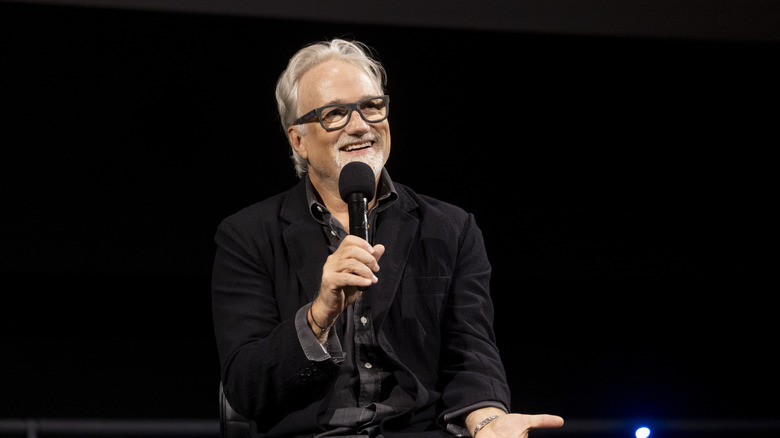
Academy Museum Foundation/Getty Images
We may receive a commission on purchases made from links.
The Formative Years: From Projection Booths to Directing
Widely celebrated as one of the most influential directors in modern cinema, David Fincher’s path to Hollywood stardom was paved with hands-on technical experience. Long before he was crafting psychological thrillers, he was honing his craft in Northern California. Interestingly, his early life was steeped in cinematic proximity; growing up in San Anselmo, he lived near George Lucas, a connection that perhaps subtly underscored the possibilities of a career in film.
Fincher’s dedication to the medium began early. After relocating to Ashland, Oregon, during his teenage years, he immersed himself in the local theater scene. Rather than just acting, he took a comprehensive approach, managing stage design, lighting schematics, and directing productions. His practical education continued behind the scenes at the Varsity Theatre, where he served as a projectionist, and at the KOBI news station, where he gained vital experience as a production assistant. These roles provided him with a granular understanding of how images are captured, projected, and edited-a technical foundation that remains evident in his meticulous directorial style today.
Transitioning to the Big Screen
Before he became a household name, Fincher was a titan of the music video industry. His visual language was defined by his work with iconic performers such as Madonna, Michael Jackson, Billy Idol, and Aerosmith. This era allowed him to experiment with lighting and pacing, skills that would eventually define his feature film aesthetic.
His leap into feature-length filmmaking arrived with the divisive “Alien 3.” While the film faced significant scrutiny upon its 1992 release, it served as a trial by fire for the director. He quickly moved past this initial hurdle, cementing his status as a visionary auteur just three years later with the release of “Se7en.” That film not only redefined the crime-thriller genre but also established the dark, atmospheric, and precise visual signature that audiences now associate with his body of work.