


Testing the Durability of the iPhone Duo: A Stress Test Analysis
The evolution of foldable phones has brought a unique set of engineering challenges, most notably the inevitable appearance of a display crease. As these devices transition from niche gadgets to mainstream hardware, consumers are rightfully concerned about how these hinges hold up over time. To address these concerns, we put the premium Apple’s new $1,999 iPhone Duo through a rigorous, accelerated life-cycle assessment.
Simulating Years of Wear and Tear
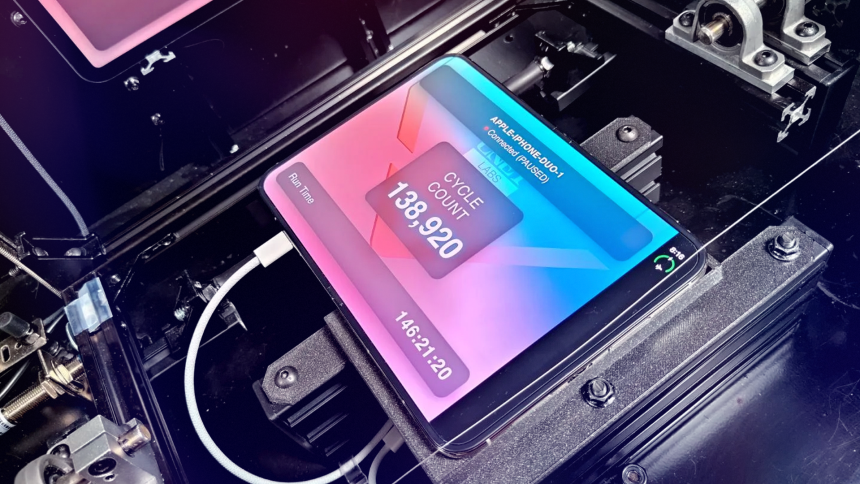
To determine the long-term structural integrity of the device, we utilized our custom-built “Fold-a-Phone” testing apparatus. By automating the folding process, we can simulate several years of heavy daily usage in just a matter of days. Our test unit has been subjected to a relentless cycle of opening and closing, and as of our latest check, the device has successfully cleared the 139,000-fold milestone.
Evaluating the Display Integrity
While industry standards for foldable longevity often hover around the 100,000 to 200,000-fold range, the iPhone Duo’s performance is particularly noteworthy. When the screen is powered down, the indentation at the hinge point is visible, which is consistent with current flexible display technology. However, our observations indicate that the severity of this mark has remained remarkably stable throughout the duration of our stress test.
For those interested in the visual evidence, our latest YouTube feature provides a detailed breakdown of the hinge’s condition. While the crease is undeniably present during the transition between the open and closed states, it has not degraded or worsened significantly since the inception of our experiment. This suggests that Apple’s hinge mechanism is designed to maintain a consistent level of performance, even under extreme mechanical stress.