





Securitize Stock Slump: Analyzing the Post-SPAC Reality for Tokenization Leaders
Securitize (SECZ), a prominent player in the tokenization space backed by industry giants like BlackRock, has faced a challenging debut on the public markets. Despite being positioned as a premier pure-play investment in the rapidly expanding blockchain-based finance sector, the company’s stock has retreated approximately 40% since finalizing its merger with Cantor Equity Partner II just last week.
This downward trajectory occurred despite a broader, optimistic outlook for the tokenization industry. Financial heavyweights-including JPMorgan, Franklin Templeton, and BlackRock-are aggressively migrating traditional financial instruments, such as credit, U.S. Treasuries, and equities, onto blockchain infrastructure. Market forecasts remain bullish: Citi analysts anticipate the tokenized asset market could hit $5.5 trillion by 2030, while projections from BCG and Ripple suggest a potential valuation of $19 trillion by 2033.
The Mechanics Behind the SPAC Volatility
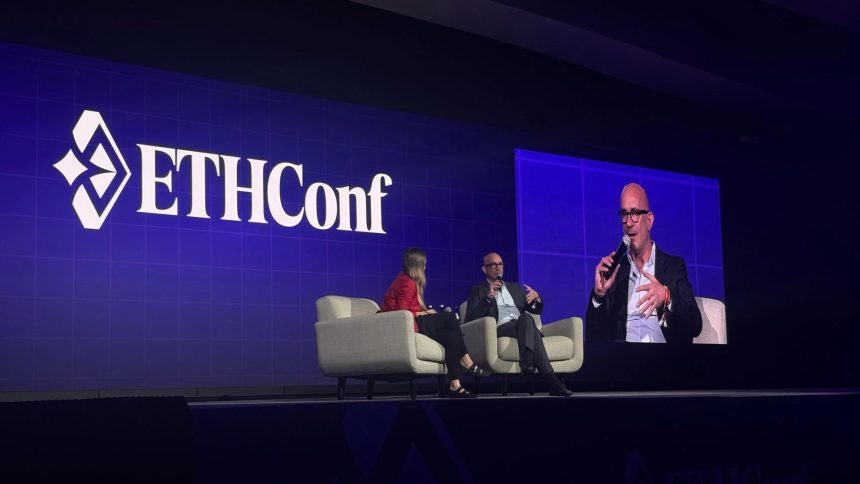
According to Jeff Dorman, Chief Investment Officer at Arca, the recent price action is less a reflection of Securitize’s internal health and more a symptom of the structural transition inherent in Special Purpose Acquisition Company (SPAC) mergers.
“We aren’t seeing any fundamental red flags,” Dorman noted. “The volatility we’re witnessing is a classic byproduct of the post-SPAC transition. You are essentially swapping out an initial investor base-often comprised of fixed-income arbitrageurs-for a new cohort of long-term equity investors who are focused on the company’s underlying business performance.”
This “investor rotation” frequently triggers significant price swings. Because SPACs function as shell companies that raise capital before identifying a target, the initial shareholders are often looking for short-term exits once the merger is finalized. As these holders sell off their positions, the stock price often experiences turbulence until it finds a stable floor among institutional and retail investors who are committed to the company’s long-term growth strategy.
A Broader Trend of Crypto-Market Skepticism
Dorman also points to a “hangover” effect impacting the entire digital asset sector. Investors have become increasingly wary of crypto-related public listings due to the lackluster performance of several high-profile debuts over the past few years.
The historical data paints a sobering picture for recent entrants:
- BitGo: Since its February listing, the digital asset custodian has seen its valuation drop by 70%.
- Gemini: The exchange has struggled significantly, trading 85% below its September debut price.
- Bullish: After an August 2025 debut at $90, the firm has shed over 70% of its value.
- Coinbase: Even the industry’s most established public player, which opted for a direct listing in 2021, is currently trading roughly 56% below its initial opening price of $381.
While Circle (CRCL) remains an outlier by trading above
Strategic Capital: How Post-IPO Liquidity Fuels Long-Term Innovation
The transition from a private entity to a publicly traded company is often viewed as the ultimate finish line for founders and early investors. However, for many CEOs, the ringing of the opening bell is merely the starting gun for a new phase of aggressive expansion. By securing a substantial “war chest” through an Initial Public Offering (IPO), leadership teams are shifting their focus from mere survival to strategic dominance.
Beyond the Balance Sheet: The Power of Public Capital
When a company goes public, the influx of capital does more than just provide a cushion; it fundamentally alters the organization’s risk appetite. With a fortified treasury, executives are no longer tethered to the short-term constraints of venture capital cycles or private equity demands.

Instead, this liquidity acts as a catalyst for “moonshot” projects. According to recent market analysis, companies that maintain high cash reserves post-IPO are 40% more likely to successfully pivot during industry downturns compared to their cash-strapped counterparts. This financial flexibility allows firms to invest in R&D, talent acquisition, and infrastructure without the immediate pressure of quarterly profitability.
Strategic Deployment: Where the Money Goes
A robust war chest is not meant to sit idle in a high-yield savings account. Modern CEOs are deploying these funds with surgical precision across three primary pillars:
* Inorganic Growth through M&A: Rather than building every solution from scratch, public companies are increasingly using their capital to acquire niche competitors. This “buy-to-build” strategy accelerates market penetration and integrates proprietary technology faster than organic development would allow.
* Talent Acquisition at Scale: In a competitive labor market, the ability to offer lucrative equity packages and top-tier salaries is a significant differentiator. A strong balance sheet allows companies to poach industry leaders who can drive innovation.
* Operational Resilience: By insulating the company against market volatility, CEOs can maintain consistent output even when the broader economy faces headwinds. This stability is often rewarded by shareholders, who prioritize long-term value over fleeting gains.
The CEO’s Perspective: Balancing Growth and Governance
The shift from private to public brings a new layer of scrutiny. CEOs must now balance the desire for rapid expansion with the fiduciary responsibilities owed to a diverse base of shareholders.
“The goal isn’t just to have cash on hand; it’s to have the agility to deploy it when the market presents a unique opportunity,” notes one industry leader. This sentiment reflects a broader trend: the most successful post-IPO companies are those that treat their war chest as a strategic asset rather than a safety net.
Future-Proofing the Enterprise
As we look toward the next decade, the definition of a “successful” IPO is evolving. It is no longer just about the valuation achieved on day one, but about the sustainability of the growth trajectory thereafter. Companies that leverage their public status to build a deep, accessible reserve of capital are better positioned to navigate the complexities of a globalized economy.
By prioritizing long-term vision over immediate dividends, CEOs are proving that a well-managed war chest is the most effective tool for maintaining a competitive edge in an increasingly crowded marketplace. The companies that thrive will be those that view their public offering as the beginning of a long-term commitment to innovation, scale, and market leadership.