





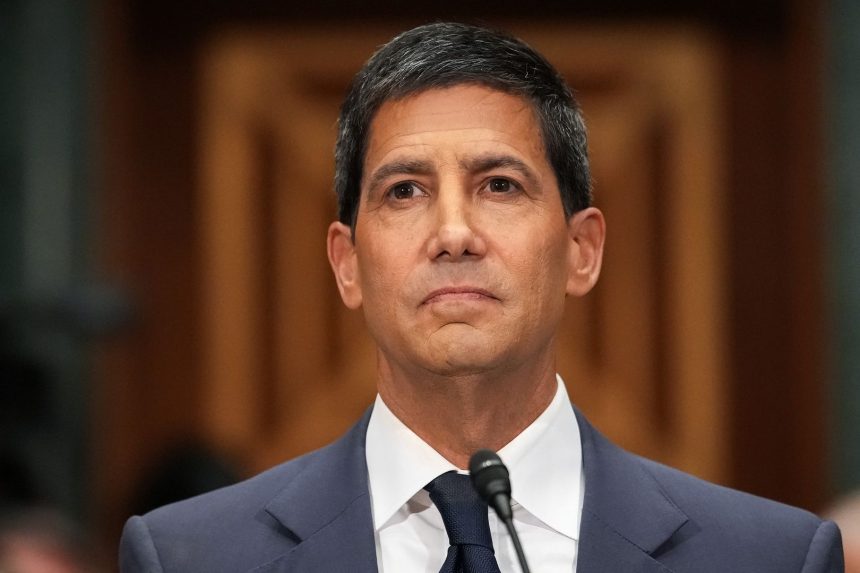
The Warsh Factor: How Jackson Hole Could Redefine Market Liquidity and Asset Valuations
The annual economic symposium at Jackson Hole has long served as a bellwether for global monetary policy, but this year’s focus on Kevin Warsh’s address has elevated the stakes for investors across traditional and digital asset classes. As market participants look for clarity on the Federal Reserve’s potential involvement in Treasury buyback programs, the ripple effects are expected to be felt far beyond the bond market, specifically impacting the price discovery mechanisms for Bitcoin and gold.
Decoding the Fed’s Treasury Strategy
At the heart of the current market anxiety is the question of how the Federal Reserve intends to manage liquidity. If Warsh signals a shift toward more aggressive Treasury buybacks-essentially a form of quantitative easing-it would likely suppress long-term yields. Historically, when the Fed intervenes to stabilize the bond market, it creates a “liquidity tide” that lifts risk-on assets.
Recent data suggests that the correlation between Fed balance sheet expansion and Bitcoin’s performance has tightened significantly over the last 18 months. With the U.S. national debt exceeding $35 trillion, any hint that the central bank will act as a buyer of last resort to keep borrowing costs manageable could serve as a massive catalyst for non-sovereign stores of value.
Why Bitcoin and Gold Are Watching Closely
While gold has traditionally been the go-to hedge against currency debasement, Bitcoin is increasingly being viewed as a “digital twin” in this specific macroeconomic context. Both assets thrive in environments where:
* Real yields remain suppressed: When the Fed keeps interest rates below the rate of inflation, the opportunity cost of holding non-yielding assets like gold and Bitcoin drops.
* Fiscal dominance concerns rise: If the market perceives that the Fed is prioritizing government debt sustainability over inflation control, investors tend to rotate out of fiat-denominated bonds and into hard assets.
For instance, during the 2020 liquidity injections, both gold and Bitcoin saw parabolic moves as the market priced in a weaker dollar. A speech from a figure like Warsh, who is often viewed as a potential future Fed leader, carries the weight of policy intent. If his remarks suggest that the Fed is willing to tolerate higher inflation to facilitate Treasury buybacks, we could see a rapid repricing of these assets.
Navigating the Yield Curve Shift
The implications for long-term yields are equally critical. A commitment to buybacks would likely flatten the yield curve, reducing the attractiveness of long-dated Treasuries. For institutional investors, this creates a dilemma: stay in the bond market and accept lower real returns, or pivot toward assets that offer a hedge against potential long-term monetary expansion.
As we approach the post-speech environment, the volatility in Bitcoin and gold will likely serve as a real-time barometer for how the market interprets the Fed’s appetite for intervention. Investors should prepare for a period of heightened sensitivity, where every nuance in the Jackson Hole rhetoric could trigger significant capital reallocation.