





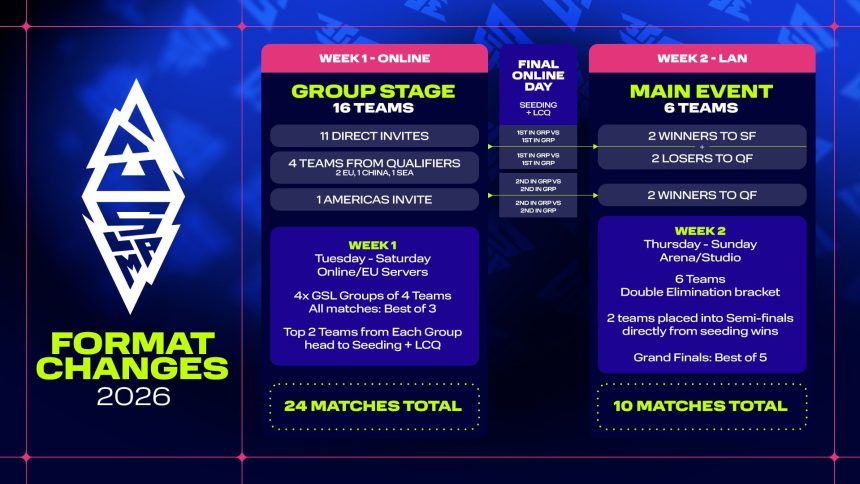
BLAST Slam has cemented its reputation as a cornerstone of the professional Dota 2 circuit. With the upcoming eighth iteration of the series, organizers are shaking up the status quo by expanding the roster of competing teams and overhauling the Group Stage structure. These adjustments promise to reshape the competitive landscape, offering a fresh dynamic for both the organizations involved and the global fanbase.
A New Era for the Group Stage: Expanding to 16 Teams
The most significant shift for BLAST Slam VIII is the expansion from 12 to 16 participating teams. This increase not only provides more opportunities for emerging squads but also ensures a higher volume of high-stakes matches for viewers.
Furthermore, BLAST is moving away from the controversial best-of-1 (BO1) format. In its place, the tournament will utilize a best-of-3 (BO3) series structure across four GSL-style groups. By adopting the GSL format-a staple in competitive gaming that utilizes a double-elimination bracket within each group-BLAST ensures that teams have a fair chance to recover from a single loss, ultimately leading to a more accurate representation of skill and consistency.
Strategic Shift in Invite Allocation
With the expanded field, BLAST has refined its invitation process to better reflect the current global power balance. Notably, the Americas region has secured a permanent direct invite. This decision acknowledges the impressive trajectory of South American Dota, where teams like PlayTime and LGD Gaming have demonstrated remarkable resilience and tactical growth, even when operating outside of traditional legacy structures.
The updated distribution of the 16 slots is as follows:
- 11 Global Direct Invites
- 1 Americas Regional Direct Invite
- 4 Regional Qualifier Slots:
- 2 from Europe
- 1 from Southeast Asia
- 1 from China