





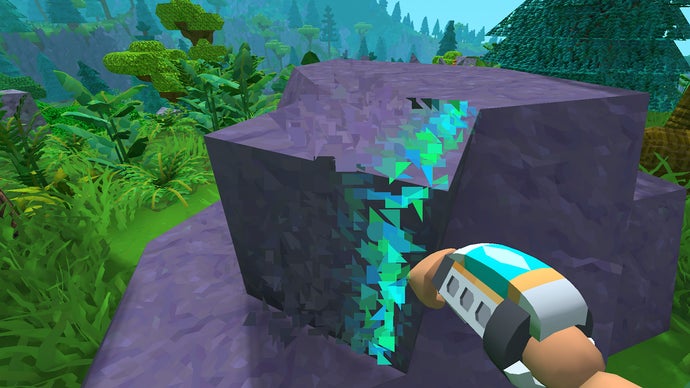
Revolutionizing Game Assets: How 4J Studios’ “Rixels” Slash Memory Usage
The team behind the upcoming title Reforj, 4J Studios, has unveiled a groundbreaking proprietary technology dubbed “Rixels.” By moving away from traditional texture mapping, the Dundee-based developer aims to solve one of the most persistent bottlenecks in modern game development: the massive memory footprint required for high-fidelity visuals. The studio has already moved to secure a patent for this innovative approach.
The Problem with Traditional Texturing
In standard game design, developers rely on rasterized textures-essentially grids of colored squares. As game worlds expand in scale and complexity, these textures demand increasingly large amounts of VRAM. Chris van der Kuyl, chairman of 4J Studios, noted that the team hit a developmental ceiling while working with standard 512×512 texture grids. As the scope of their project grew, the sheer volume of data required to maintain visual quality threatened to overwhelm system resources.
What are Rixels?
To circumvent these hardware limitations, CTO Richard Reavy engineered the “Rixel” (Reforj Pixel). Unlike a standard pixel, which is a static point of color, a Rixel functions as a container for a specific vector shape. By utilizing a library of 23 distinct vector forms, the engine can construct complex surfaces using mathematical equations rather than static image files.
This shift to vector-based rendering offers two primary advantages:
- Infinite Scalability: Because vector graphics are defined by geometry rather than a fixed grid, they remain perfectly crisp regardless of how close the player gets to an object. This eliminates the “blurriness” often seen when a camera zooms in on a low-resolution texture.
- Drastic Memory Efficiency: By replacing heavy image files with lightweight mathematical instructions, the studio has reported a staggering 98% reduction in texture memory requirements.
A New Standard for Open-World Performance
The implications of this technology are significant for the industry. As games continue to push for larger, more immersive environments, the ability to maintain high-quality assets without ballooning file sizes is critical. For context, modern AAA titles often require upwards of 100GB of storage, with a significant portion dedicated to high-resolution texture maps. If 4J Studios’ Rixel technology can be scaled effectively, it could allow developers to create expansive, detailed worlds that run smoothly on a wider range of hardware, from high-end PCs to mobile devices and consoles.