


The Long-Awaited Return: Reflecting on the Tesla Roadster’s Decade-Long Journey
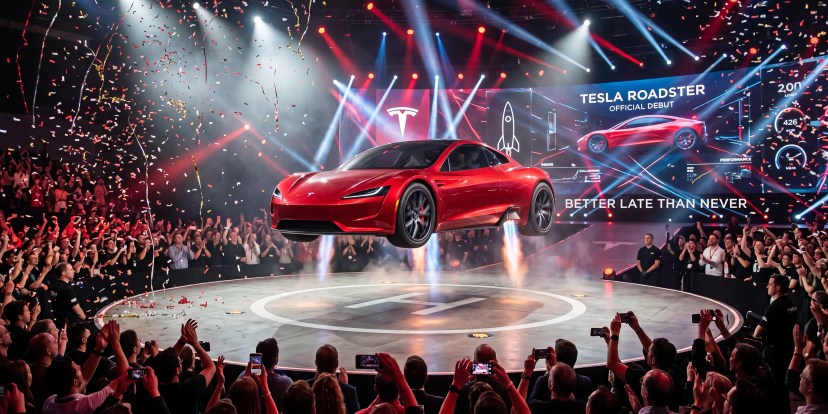
Back in November 2017, the atmosphere at a Hawthorne airfield was electric, centered on the anticipated debut of Tesla’s heavy-duty semi-truck. However, the evening took a legendary turn when the stage lights faded and a vibrant, crimson sports car emerged from the shadows. This was the unveiling of the second-generation Roadster, a vehicle that immediately redefined expectations for battery-powered performance.
Redefining the Electric Supercar Aesthetic
The initial specifications were nothing short of revolutionary for the time: a four-seat configuration, an impressive 620-mile highway range, and a blistering acceleration time of under two seconds to reach 97 km/h. Beyond the raw data, the design language was a masterclass in minimalism. While traditional Italian supercars often rely on aggressive, complex aerodynamics and busy body lines, the Roadster opted for a sleek, athletic silhouette. It presented a clean, low-slung profile that made the ornate designs of legacy combustion-engine exotics appear unnecessarily cluttered.
A Decade of Anticipation and Engineering Evolution
It has now been nearly nine years since that reveal, a timeframe that represents a lifetime in the automotive industry. In the world of vehicle development, nine years is typically sufficient to conceive, engineer, and launch two complete platform generations. The automotive landscape has shifted dramatically since 2017; for context, the global electric vehicle market has grown from roughly 1 million annual sales to over 14 million in 2023, according to the International Energy Agency. As the industry moves toward solid-state batteries and advanced autonomous integration, the Roadster remains a symbol of Tesla’s ambitious, albeit delayed, vision for the future of high-performance driving.