


# A Neon-Soaked Mystery: Our Take on Brad Bird’s Ray Gunn
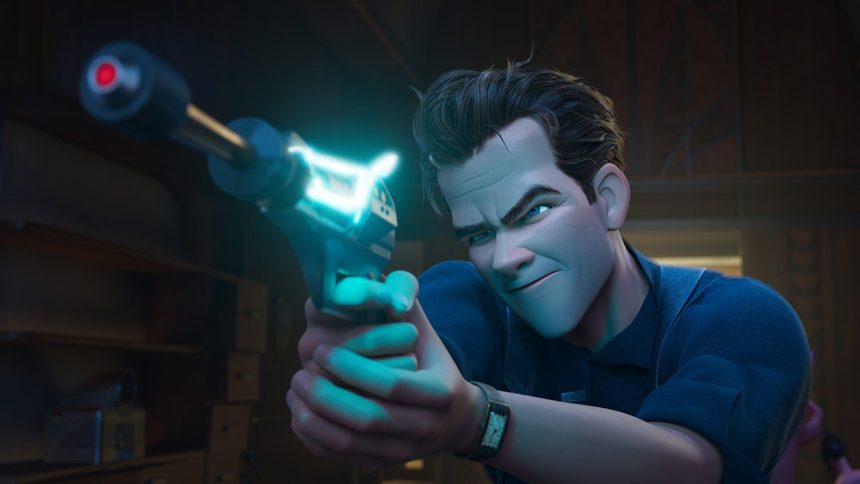
After three decades of development, Brad Bird’s long-gestating vision has finally hit the screen. *Ray Gunn* serves as a stylistic collision between the hard-boiled detective tropes of the 1940s and the high-concept aesthetic of retro-futurism. While the film is a visual triumph, it occasionally struggles under the weight of its own ambition.
*Ray Gunn* made its grand debut at the London Film Festival on October 10, 2026. For those eager to catch it, the film hits select cinemas on December 4 before making its streaming debut on Netflix on December 18.
## A Genre-Bending Noir in Metropia
The narrative unfolds within the sprawling, vertical labyrinth of Metropia. The story centers on the eponymous private investigator, voiced with gravelly charm by Sam Rockwell, and his unconventional sidekick-a one-eyed extraterrestrial named Eye-Ra, brought to life by the distinct vocal stylings of Tom Waits.
The duo finds themselves entangled in a high-stakes conspiracy involving the global music icon Venus Nova (Scarlett Johansson). As the investigation deepens, the plot spirals into a dark web of homicide and systemic corruption. This isn’t the lighthearted fare one might expect from the director of *The Incredibles* or *Ratatouille*; instead, it embraces a cynical, shadow-drenched atmosphere reminiscent of classic detective fiction like *The Maltese Falcon*.
## Maturing the Medium
It is refreshing to see Bird pivot toward a more mature narrative framework. While the animation industry has historically been tethered to family-friendly demographics, *Ray Gunn* proves that the medium is a versatile tool for adult storytelling. By leaning into the “tech-noir” aesthetic, the film challenges the notion that animation must be synonymous with childhood entertainment.
## The Verdict: Style vs. Substance
Visually, the film is a masterpiece of world-building. Every frame of Metropia feels lived-in, dripping with neon-lit atmosphere and intricate mechanical detail. However, the film is not without its flaws. The pacing suffers from an extended runtime that occasionally causes the narrative momentum to stall. Furthermore, while the world is immersive, the plot occasionally feels burdened by clunky exposition that detracts from the otherwise sharp dialogue.
Despite these minor narrative stumbles, *Ray Gunn* remains a bold experiment. It is a testament to Bird’s persistence and a reminder that animation can-and should-explore the darker, more complex corners of human (and alien) nature.