





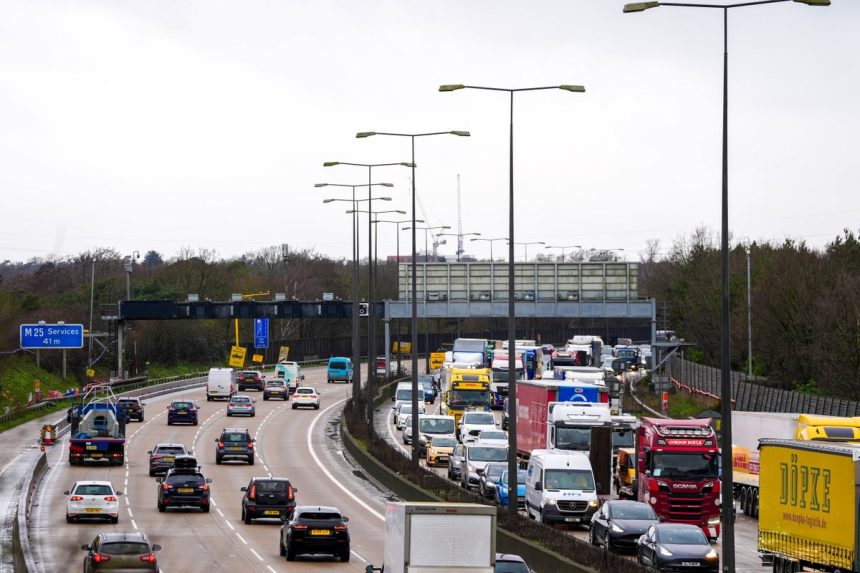
Four Decades of the M25: Analyzing Britain’s Busiest Orbital Motorway
As the M25 celebrates its 40th anniversary this October 29th, recent analytical data highlights the persistent struggle of navigating London’s primary orbital route. While the motorway remains a vital artery for the UK, new findings from vehicle telematics firm Geotab underscore just how drastically traffic flow fluctuates depending on the time of day.
The Western Corridor: A Bottleneck Hotspot
The research indicates that the western quadrant of the motorway-specifically the stretch spanning junctions 10 through 20-consistently ranks as the most congested. This area, which serves as a critical nexus for the M3, M4, and M40 interchanges and provides essential access to Heathrow airport, experiences severe delays during rush hour.
Data collected over a 12-month period (September 2025 to August 2026) reveals a stark contrast in travel times:
* Junction 14 to 15 (Clockwise): During the 4:00 PM peak, commuters face an average transit time of 9.2 minutes. By 7:00 PM, that same journey drops to just 3 minutes.
* Junction 17 to 16 (Anticlockwise): Morning commuters heading toward Denham from Mill End face a 15.6-minute slog at 7:00 AM, whereas the evening commute takes less than half that time (6.6 minutes).
Understanding the Data
To ensure accuracy, the study examined 46 of the motorway’s 58 distinct sections, analyzing both directions independently. Despite the notorious reputation of these bottlenecks, the broader data suggests that, on average, vehicles across the network maintain at least 80% of the posted speed limit. This indicates that while specific interchanges near major hubs are prone to gridlock, the motorway generally functions as intended during off-peak hours.
Beyond the Traffic: Hidden Features of the 117-Mile Route
While the M25 is often defined by its congestion, the 117-mile loop contains unique engineering feats that often go unnoticed by the average driver. For instance, near Epping, the Bell Common Tunnel serves as a fascinating example of urban integration, running directly beneath a local cricket pitch-a stark contrast to the high-speed traffic flowing through the concrete artery below.
As the motorway enters its fifth decade, these insights serve as a reminder of the delicate balance between maintaining the UK’s infrastructure and managing the ever-increasing demand of modern transit.