



Transforming Retro Classics: 3dSenVR 2.0 Brings Depth to 8-Bit Gaming
The landscape of retro gaming is undergoing a significant shift as developers find innovative ways to bridge the gap between classic 8-bit aesthetics and modern immersive technology. Geod Studio has officially launched a substantial update for 3dSenVR, its specialized emulator that breathes new life into legacy NES titles by converting flat, two-dimensional sprites into fully realized 3D environments.
Modernizing the Retro Experience with OpenXR
The latest iteration, version 2.0, marks a technical milestone for the platform. By integrating OpenXR-the industry-standard API for high-performance VR and AR-the software now offers broader compatibility across the PC VR ecosystem. This transition ensures that the emulator remains future-proof, allowing for smoother performance and more reliable hardware communication. Whether you are utilizing a high-end tethered headset or streaming via wireless solutions like Air Link or Virtual Desktop, the software is designed to maintain a consistent, low-latency experience that is crucial for the fast-paced nature of classic platformers.
Enhanced Control Schemes and Interface Overhauls
Beyond the underlying engine improvements, Geod Studio has focused heavily on user experience. The 2.0 update introduces a completely revamped library interface, making it easier for enthusiasts to navigate their personal collections. Furthermore, the addition of comprehensive button remapping allows players to tailor their control schemes to their specific VR hardware, including support for Steam Frame controllers. These visual and functional adjustments ensure that the act of playing feels as intuitive as it does nostalgic.
How It Works: Bringing 8-Bit Worlds to Life
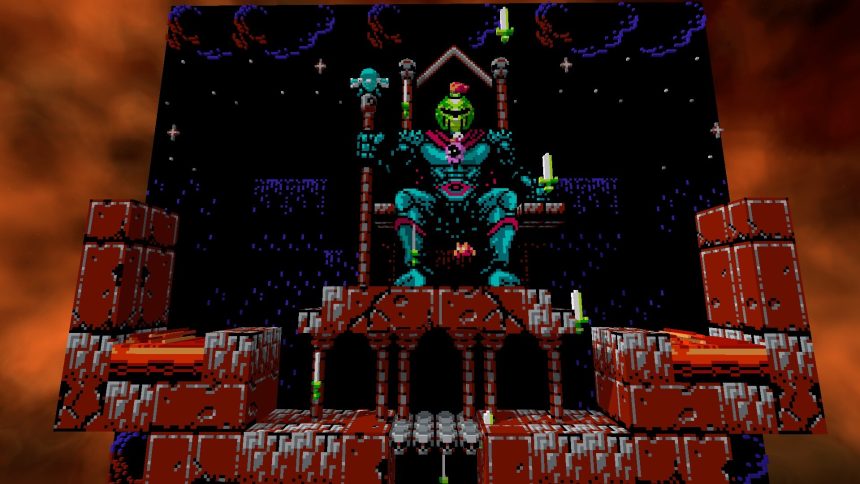
It is important to note that 3dSenVR functions strictly as an emulation engine. The software does not come pre-loaded with Nintendo’s proprietary intellectual property; users are required to provide their own legally obtained ROM files. Once loaded, the emulator’s proprietary algorithms analyze the 2D data and project it into a three-dimensional space, effectively turning a flat screen into a diorama that players can step inside.
This approach mirrors the way modern game engines handle “2.5D” assets, where depth is simulated to create a sense of scale that was impossible on original 1980s hardware. While the original NES was limited to a fixed resolution of 256×240 pixels, this VR transformation allows these iconic worlds to feel expansive, providing a fresh perspective on titles that have been played the same way for decades.