





Beyond the Landing Leg: China’s Innovative Net-Based Rocket Recovery
For years, the aerospace industry has viewed the SpaceX model-characterized by vertical landings on drone ships or concrete pads using deployable legs-as the gold standard for rocket reusability. However, a recent breakthrough from China suggests that the path to sustainable spaceflight may have more than one route. On July 10, 2026, China successfully demonstrated a novel recovery technique that swaps traditional landing gear for a high-tension cable net system.
## A New Paradigm in Booster Retrieval
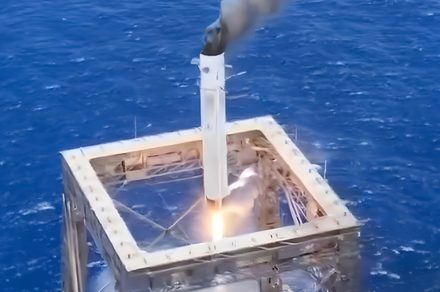
The mission took place at the Wenchang Spacecraft Launch Site in Hainan, where the Long March 10B rocket ascended at 12:15 PM local time. Roughly 360 seconds into the flight, the first stage detached and initiated a precision-guided descent. Instead of performing a propulsive touchdown on a flat surface, the booster was intercepted mid-air by a specialized recovery vessel, the *Linghangzhe*, which utilized a massive, reinforced cable net to secure the hardware.
This achievement marks a historic milestone: it is the first time an orbital-class booster has been captured using a net-based system. While SpaceX relies on the kinetic stability of landing legs, China’s approach effectively turns the recovery ship into a giant catcher’s mitt, potentially reducing the structural weight required for landing gear and simplifying the landing sequence.
## Technical Specifications of the Long March 10B
The Long March 10B is a medium-lift vehicle designed to compete in the increasingly crowded commercial launch market. With a payload capacity of approximately 16 metric tons to low-Earth orbit (LEO), it sits just below the performance threshold of the workhorse Falcon 9.
The propulsion architecture is
Emerging Frontiers: From Solar Geoengineering to Virtual Cosmos
The landscape of consumer technology and scientific discovery is shifting rapidly. As we navigate an era defined by both climate volatility and digital immersion, three distinct developments are reshaping our relationship with the planet and the stars.
Solar Geoengineering: A Radical Response to El Niño
The concept of “dimming the sun”-technically known as solar radiation management-often feels like the plot of a dystopian thriller. Yet, a pivotal study published on July 8, 2026, in Science Advances suggests that this controversial strategy might be a necessary intervention against the escalating threats of climate change.
As a record-breaking Super El Niño develops in the Pacific, meteorologists anticipate a surge in catastrophic flooding, unprecedented heatwaves, and intensified wildfire seasons. Drawing parallels to Australia’s devastating “Black Summer” bushfires, researchers at UC San Diego’s Scripps Institution of Oceanography, including Kate Ricke and Jessica Wan, argue that we must move beyond skepticism. Their research posits that controlled solar dimming could act as a global thermostat, potentially mitigating the most extreme impacts of these climate cycles. While the ethics remain debated, the scientific community is increasingly viewing this as a viable “break-glass-in-case-of-emergency” protocol.
Immersive Astronomy: The Smithsonian’s VR Revolution
Traditional planetariums have long relied on passive observation, requiring audiences to remain stationary while gazing at a dome. The Smithsonian’s latest initiative, Starstruck, shatters this mold by integrating Virtual Reality to provide a visceral, kinetic experience of the cosmos.
Rather than simply viewing a projection, visitors can now navigate through the vacuum of space, maneuvering past dying stars and approaching the event horizon of a black hole. This exhibit transforms abstract astronomical data into a tangible sense of scale, allowing the public to grasp the sheer vastness of the universe. With entry prices starting at $18, this exhibit democratizes space exploration, offering an educational experience that feels less like a lecture and more like an interstellar journey.



The Satellite Dilemma: Protecting Our View of the Heavens
The global push for ubiquitous satellite internet has undeniably bridged the digital divide, providing high-speed connectivity to remote corners of the globe. However, this technological triumph comes with a significant astronomical cost.
The European Southern Observatory (ESO) has issued a stark warning: the proliferation of satellite mega-constellations-often referred to as orbital data centers-is threatening the integrity of ground-based astronomy. As thousands of satellites reflect sunlight, they create “light pollution” in the upper atmosphere, leaving streaks across long-exposure images captured by the world’s most powerful telescopes.
Current data suggests that if the current rate of satellite deployment continues, we risk rendering significant portions of the night sky effectively “blind” to terrestrial observatories. Astronomers are now calling for stricter international regulations to ensure that our pursuit of global connectivity does not permanently obscure our window into the origins of the universe.